
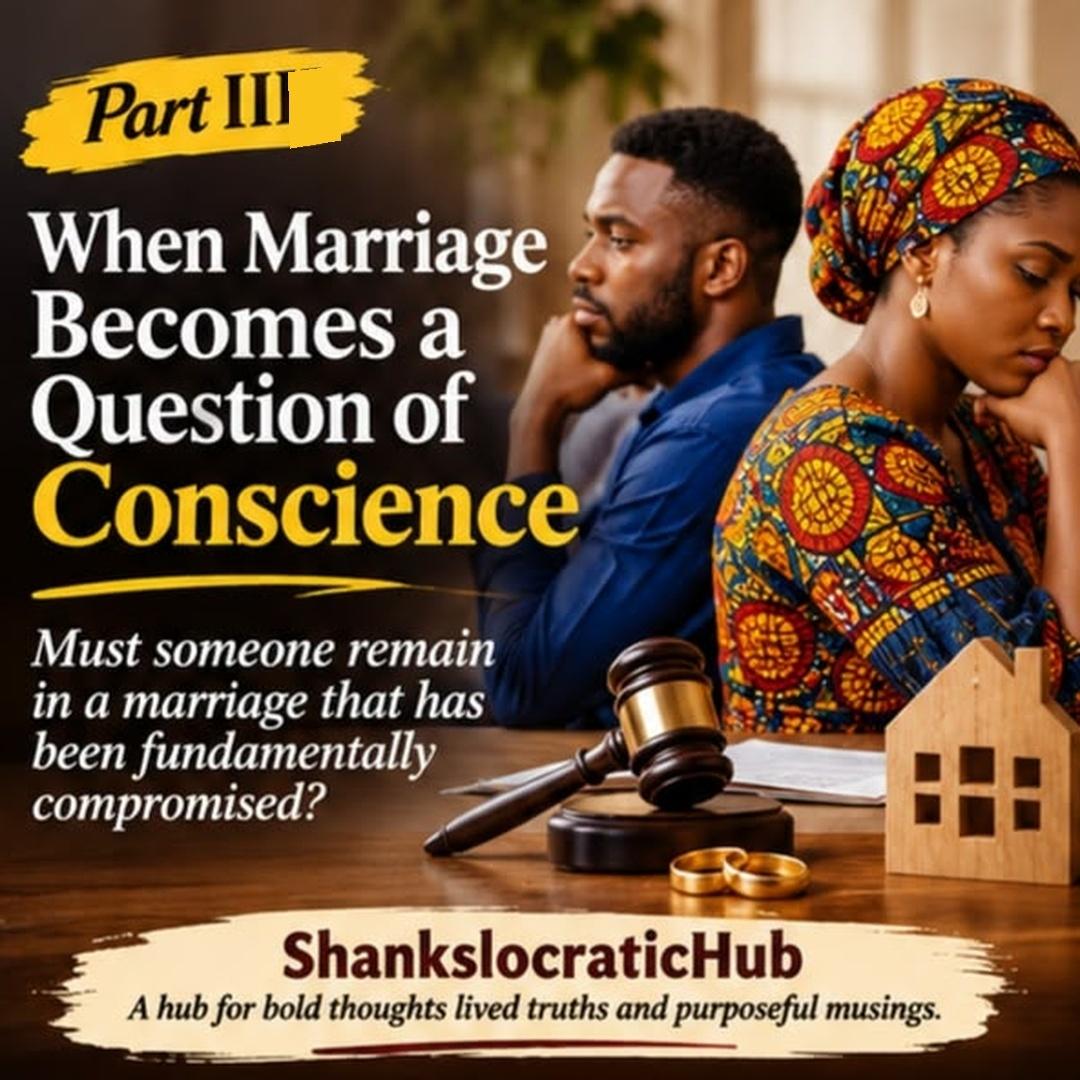
MARRIAGE, DIVORCE, REMARRIAGE AND THE CHURCH (III)
When Marriage Becomes a Question of Conscience
It is relatively easy to discuss marriage when we are examining it from the comfort of a church pew, quoting familiar scriptures and explaining what a husband or wife ought to do.
It becomes a different conversation when you are the person living through the circumstances.
Imagine you are a man who enters into a customary marriage with genuine intentions. You invest almost seven years in building a home, navigating responsibilities, making sacrifices and trying to sustain the relationship.
Then, circumstances emerge that force you to confront a deeply uncomfortable reality involving paternity fraud, deliberate deception and a possible breach of marital fidelity.
Suddenly, you are faced with a question that is considerably more complicated than the familiar instruction that what God has joined together should not be separated.
Does walking away from such a marriage necessarily amount to disobeying God?
Let's examine the circumstances.
If you discover that a child you have been led to believe is biologically yours was conceived through an extramarital relationship during your marriage, would that not raise the very question of adultery addressed by Jesus in Matthew 19:9?
Of course, paternity fraud and adultery are not automatically interchangeable. A child may not be biologically related to the presumed father for different reasons, and the timing and circumstances of conception matter. But where deliberate deception conceals an extramarital sexual relationship during marriage, we are dealing with a serious breach of marital fidelity, not merely a disagreement over domestic responsibilities.
Would you be expected to remain in that marriage regardless of the emotional and psychological consequences?
Would choosing separation automatically make you the person acting against God's expectations? Or could walking away be an understandable response to a relationship whose foundation of trust has been fundamentally compromised?
These are not questions to be answered with convenient religious slogans.
Matthew 19:9 gives particular attention to sexual immorality. Meanwhile, 1 Corinthians 7:10–16 addresses separation, reconciliation and the circumstances surrounding abandonment.
There are different Christian interpretations of how these passages apply to a situation involving deception, infidelity and the eventual breakdown of a marriage. We should acknowledge those differences rather than manufacture a simple answer where theological disagreement genuinely exists.
But there is another dimension to this conversation, particularly within the Nigerian setting: customary marriage.
Many couples enter marriage through traditional rites recognised by their respective communities. Such marriages are not less meaningful simply because they were not contracted under the Marriage Act.
However, the procedures for dissolving customary marriages are not uniform throughout Nigeria. They depend on the applicable customary law and may involve family intervention, the return of bride price or formal proceedings before a competent customary court.
Consequently, physical separation after several years does not necessarily establish that every legal and customary requirement for dissolution has been fulfilled.
This distinction matters, particularly when either party eventually wishes to remarry.
Now, what does forgiveness have to do with all this?
Quite a lot, actually.
Some people interpret forgiveness as an obligation to return to the relationship. Others believe that reconciliation must always be the ultimate objective, irrespective of what happened.
But forgiveness and reconciliation are not identical.
You may forgive someone without restoring the relationship to what it once was. Reconciliation requires more than the willingness of one person. It involves honesty, genuine remorse, accountability and a willingness to rebuild what has been damaged.
And sometimes, despite those possibilities, a relationship may not be recoverable.
This is not an argument against marriage. It is an acknowledgement that marriage involves two people whose decisions, conduct and responsibilities affect one another.
We should encourage reconciliation where it is possible and healthy, but we must be careful not to turn the preservation of a marriage into an excuse for overlooking deception, betrayal or other serious violations of trust.
So, must everyone become a Hosea?
Must every betrayed spouse remain committed regardless of the circumstances?
And must someone who has experienced a failed marriage automatically surrender the possibility of companionship for the rest of their life?
I do not believe these questions should be dismissed without serious scriptural consideration.
Neither should Ruth's story be casually presented as a direct justification for every divorced person's remarriage. Her circumstances were different. The biblical text deserves that distinction.
Perhaps what we need is a more mature understanding of marriage, one that recognises its sacredness without overlooking the dignity, responsibilities and realities of the people involved.
God's Word should not be rewritten to accommodate our preferences. But neither should it be reduced to isolated verses used to pronounce judgment on people whose circumstances we have not taken the time to understand.
At the end of the day, marriage deserves commitment, fidelity, honesty and sacrifice. But accountability must be mutual, and the responsibility to uphold marital values cannot rest on only one party.
If we insist on preserving the institution of marriage, we must also be willing to confront the conduct that undermines it.
And if we insist on holding people accountable for their marital decisions, we must be prepared to examine the circumstances fairly, apply Scripture in its proper context and distinguish between personal conviction and established biblical instruction.
Perhaps that is where the real conversation should begin.
Not with who deserves condemnation, who should remain unmarried or who has the right to start again, but with what Scripture actually teaches, what justice requires and how we treat people when the realities of life become considerably more complicated than the sermons we have heard.


Comments
Log in to join the conversation