
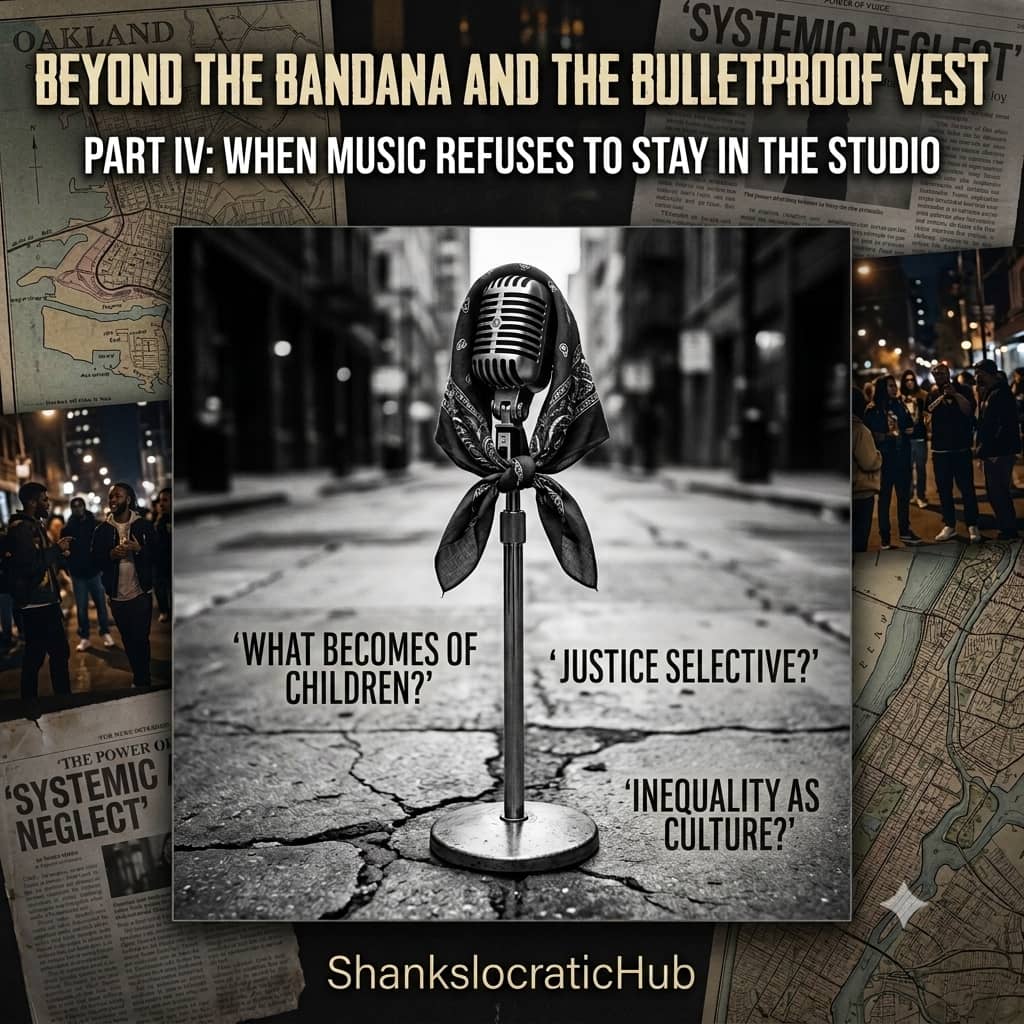
Beyond the Bandana and the Bulletproof Vest (Final Part)
Part IV: When Music Refuses to Stay in the Studio
The previous reflection ended with a paradox: while the world debated who Tupac Shakur was, his music had quietly been asking far larger questions about the society that shaped him. That is the enduring power of his catalogue. Some songs fade with the final note. Others continue because they were never merely songs. They were conversations disguised as music.
Tupac's greatest achievement was not commercial success. It was his refusal to let listeners remain comfortable. Whether confronting racism, poverty, policing or inequality, his music consistently challenged audiences to look beyond individual stories and examine the structures surrounding them.
Few songs illustrate this better than Changes. More than a protest anthem, it functions as public sociology. Racism is not reduced to personal prejudice. Poverty is not dismissed as individual failure. Police brutality is not treated as an isolated incident. Each is presented as part of a larger ecosystem where history, institutions and everyday experiences reinforce one another. That is why the song continues to resonate. Societies often search for single causes because they promise simple solutions. Real life rarely offers that luxury.
The same layered thinking defines Ghetto Gospel. It imagines healing without pretending healing is easy. It acknowledges communities exhausted by violence while refusing to surrender hope. In Tupac's world, hope is never naïve. It is resilient. It survives because surrender would allow injustice to write the final chapter.
That longing reaches perhaps its most vulnerable expression in Thugz Mansion. For a man remembered through conflict, the song reveals an almost childlike desire for peace. Not victory. Not revenge. Peace. There is quiet tragedy in that contrast. The artist remembered for aggression repeatedly imagined rest, while the public remained captivated by the noise that surrounded him.
Even I Ain't Mad at Cha reveals a maturity often overlooked. Beneath its story of changing friendships lies a meditation on forgiveness, growth and the inevitability of separation. Tupac understood that people evolve, circumstances change and not every ending requires resentment.
Yet these moments rarely became the defining headlines.
Instead, Hit 'Em Up became shorthand for his identity, while quieter works were treated as exceptions. The imbalance says as much about audiences as it does about Tupac. Conflict sells. Complexity demands patience. Media institutions rewarded confrontation because confrontation attracted attention. The thoughtful poet asking why violence had become ordinary received far less notice than the controversial celebrity caught in it.
That pattern reflects something larger than one artist. It reveals a persistent tendency to distrust stories emerging from marginalized communities. When affluent communities describe suffering, society often calls it tragedy. When poor communities do the same, their testimony is more readily dismissed as complaint. Tupac challenged that double standard by refusing to sanitize his environment. He described addiction without glamour, violence without denial and survival without pretending survival itself was justice.
That is why his legacy extends far beyond hip-hop.
Long before terms such as systemic neglect and institutional racism entered mainstream conversations, Tupac translated those realities into stories ordinary people could feel. He invited listeners to ask not merely what happened, but what happened before what happened. That second question transforms crime into context, addiction into history, violence into consequence and poverty into policy. It does not erase personal responsibility. It simply refuses to isolate it from collective responsibility.
Perhaps the greatest injustice done to Tupac was never the criticism he received. It was the selective listening. Too many heard the volume without hearing the vocabulary. Too many noticed the bandana but ignored the books. Too many replayed the controversy while overlooking the compassion.
In the end, the most important subject was never Tupac.
It was us.
The societies we build.
The inequalities we normalize.
The labels we weaponize.
The communities we abandon.
The histories we refuse to confront until they return demanding attention.
His music still unsettles listeners decades after his death not because it belongs to the 1990s, but because too much of it still belongs to the present. Beyond the bandana, beyond the feuds and beyond the mythology stands a young man asking questions that remain painfully contemporary.
What becomes of children raised on neglect?
What happens when justice feels selective?
Who benefits from stereotypes?
How long can inequality survive before it becomes culture?
Those questions were never confined to a recording studio.
They were addressed to society.
And society is still writing its answer.




4 comments
Log in to join the conversationNice read
I've enjoyed every single one of your articles, please keep it up 😉
Thank you.
Finalllyyy, what an amazing thread