
Beyond the Bandana and the Bulletproof Vest
Part III: The War Between the Man and the Myth
The previous reflection traced the roots of Tupac's social conscience to his upbringing, his mother's activism and the realities of communities shaped by neglect. Yet history rarely remembers people only as they were. It also remembers them as they were marketed, criticized and mythologized. Few public figures illustrate that divide more vividly than Tupac Shakur.
Every public figure eventually acquires two biographies.
One belongs to the person.
The other belongs to the public imagination.
In Tupac's case, the distance between them became enormous.
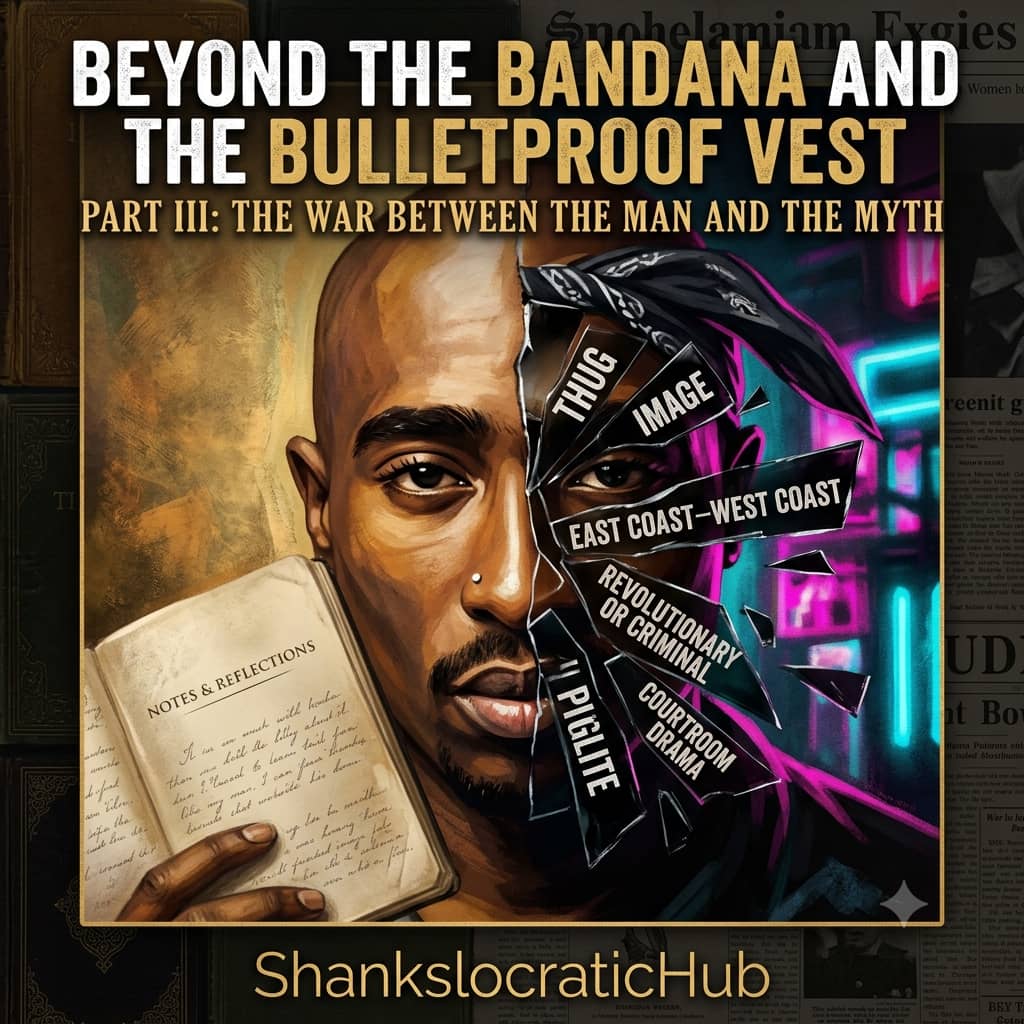
The public biography was loud. It featured legal troubles, volatile interviews, the East Coast–West Coast rivalry and an image that media outlets found impossible to resist. The private biography was quieter. It revealed a voracious reader, a trained actor, a poet who filled notebooks with reflections, and a son whose deepest emotional compass repeatedly pointed back to his mother.
Once society decided Tupac was a "thug," even his complexity became evidence against him. His tenderness was dismissed as inconsistency. His political reflections became footnotes to controversy. His compassion struggled to compete with the commercial value of outrage.
This is where sociology offers another useful lens.
Symbolic interactionism reminds us that meanings are created and reinforced through social interaction. Labels matter because people eventually respond less to who someone is than to what society has collectively agreed they represent.
A label becomes a prison not because it is true, but because it becomes believable.
Few labels illustrate this better than thug. On the surface, the word appears race-neutral. In practice, it has often carried assumptions of danger, criminality and moral deficiency while avoiding explicit racial language. Tupac understood that power, which is precisely why he reclaimed the term through THUG LIFE. He was not celebrating violence. He was redirecting attention toward the conditions that manufactured despair in the first place.
Not absolution.
Accountability.
Ignore struggling schools today. Disinvest from neighbourhoods tomorrow. Treat generations of children as disposable. Eventually the consequences return wearing different names: crime, addiction, fractured families and incarceration. The bill always arrives. Society simply argues over who should pay it.
Tupac himself embodied contradictions that critics often mistook for hypocrisy. He could write Keep Ya Head Up and later unleash the fury of Hit 'Em Up. He could celebrate life in I Get Around or Picture Me Rollin' while exposing loneliness in Me Against the World. Those contrasts were not evidence of a fractured philosophy. They were evidence of a deeply human one.
People living under extraordinary pressure rarely present perfectly coherent identities. Trauma produces emotional whiplash. Some days demand tenderness. Others reward hardness. Tupac never edited those tensions into something more acceptable. He performed them honestly.
That honesty also echoes through Hail Mary. Beneath its ominous atmosphere lies a man wrestling with betrayal, mortality and the possibility that peace may never arrive while he is alive. It is less the soundtrack of violence than the sound of someone exhausted by it.
Even his celebratory records deserve closer attention. Songs such as I Get Around and Picture Me Rollin' remind us that marginalized communities do more than survive. They laugh, celebrate, flirt, dance and seize moments of joy. In communities repeatedly defined by deprivation, joy itself becomes an act of resistance.
Perhaps that is why the debate over who Tupac "really was" has never ended.
He was neither the flawless revolutionary some admirers imagine nor the one-dimensional outlaw his critics preferred.
He was a contradiction because life itself is one.
Yet while the world argued over the man, his music had quietly been asking larger questions about society. To hear those questions is to discover that some songs never really end when the beat stops.



10 comments
Log in to join the conversationA lot really went down then
He was an amazing person
Nice
Bro suffered o no be small
This guy had to go through so much 🤧
Being branded criminal is smth a lot of blacks dealt with, even nowadays
What a legend he is
What a legend 👏
Oh this is a continuation
Keep it up 💯