
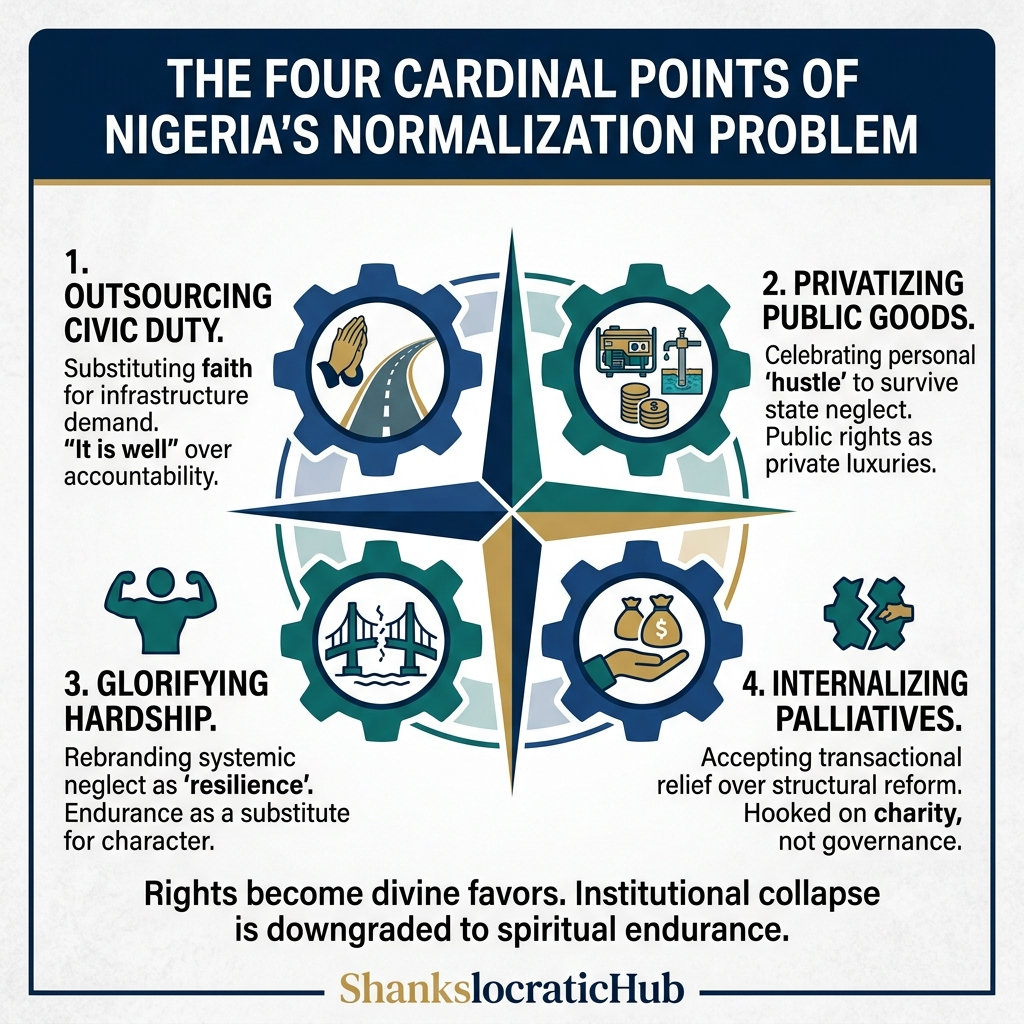
The Four Cardinal Points of Nigeria’s Normalization Problem
One of modern Nigeria’s most quietly destructive cultural shifts is the substitution of faith and individual resilience for civic accountability. When a society begins treating functioning infrastructure, public safety, and basic social contracts as answered prayers, the standard for acceptable governance drops to zero. Rights become reframed as divine favors, and institutional collapse is downgraded to a personal test of spiritual endurance.
To understand how deep this passivity runs, we must examine the four cardinal points anchoring our normalized dysfunction:
1. The Outsourcing of Civic Duty to the Divine
Basic state responsibilities are routinely spiritualized into personal battles:
"God will keep us safe" replaces the collective demand for paved highways, street lighting, and law enforcement.
"By His stripes, I am healed" becomes the default healthcare plan in place of funded, functional hospitals.
"It is well" acts as a national sedative, neutralizing righteous indignation before it can convert into organized civic action.
Faith provides personal fortitude, but when religious fatalism shields political incompetence, it strips power of accountability. When suffering is processed as a spiritual trial rather than a policy failure, leaders are left entirely off the hook.
2. The Privatization of Public Goods as Individual Virtue
State neglect has been rebranded as a challenge overcome through private hustle. Providing one’s own electricity, security, water, and road maintenance is celebrated as a badge of honor rather than recognized as a massive governance breakdown. The societal baseline shifts from "Why is the state failing us?" to "Work harder so you can afford your own private version of public utilities." Public rights are thus quietly converted into private luxuries.
3. The Glorification of Unnecessary Hardship
Enduring preventable systemic failure is romanticized as a cultural flex. The phrase "the resilient Nigerian spirit" is invoked to praise citizens for surviving conditions that ought to spark outrage. When hardship is glorified, endurance becomes a substitute for character. We take pride in how much friction we can absorb rather than questioning why the friction exists, ensuring the impulse to fix the system dies quietly.
4. The Internalization of the "Palliative" Mindset
We have surrendered the expectation of long-term institutional building in exchange for short-term, transactional relief. Policy failures are met with emergency packages, and private philanthropy routinely substitutes for public duty. By celebrating sporadic crumbs over repeatable systems, we condition ourselves to accept charity in place of governance. A society hooked on palliatives will never demand a welfare state.
The true tragedy of our normalization problem is not that we have adapted to broken systems, but that we have mistaken our adaptability for strength. God does not run water through municipal pipes, nor does faith lay asphalt on dangerous highways; human organization, political will, and unyielding civic standards do. So long as we wear institutional neglect as a badge of honor, we remain trapped in an endless loop of unnecessary survival. The shift begins when we stop asking Heaven to deliver what the state was built to execute, and start demanding that our reality reflect our worth.




6 comments
Log in to join the conversationOne of Nigeria's deepest cultural problems is the replacement of civic accountability with religious dependence and personal resilience. Instead of demanding competent governance, many people have come to see functioning roads, electricity, security, healthcare, and other basic public services as blessings or miracles rather than rights.
This shift lowers expectations of government, making institutional failure seem normal. Citizens increasingly interpret poor governance as a test of faith or patience instead of something leaders should be held responsible for. As a result, accountability weakens, public institutions continue to deteriorate, and societal dysfunction becomes normalized.
The introduction ends by stating that this culture of passivity is sustained by four "cardinal points" that explain why Nigerians continue to accept systemic failure, beginning with "The Outsourcing...", which presumably explores the first of those four pillars
This is the summary for those who need it
Smiles.
Which of these four cardinal points do you see playing out the most in your daily routine, and what is one small way we can start breaking the cycle? Drop your thoughts below 👇
It's glorifying hardship for me
A lot of things that we enjoy that are supposed to be rights have been meted out to us as privileges