
When Permission Unmasks the Human Heart
The most dangerous monsters in history have rarely announced themselves as monsters. More often, they arrived as ordinary people who simply discovered that no one was going to stop them.
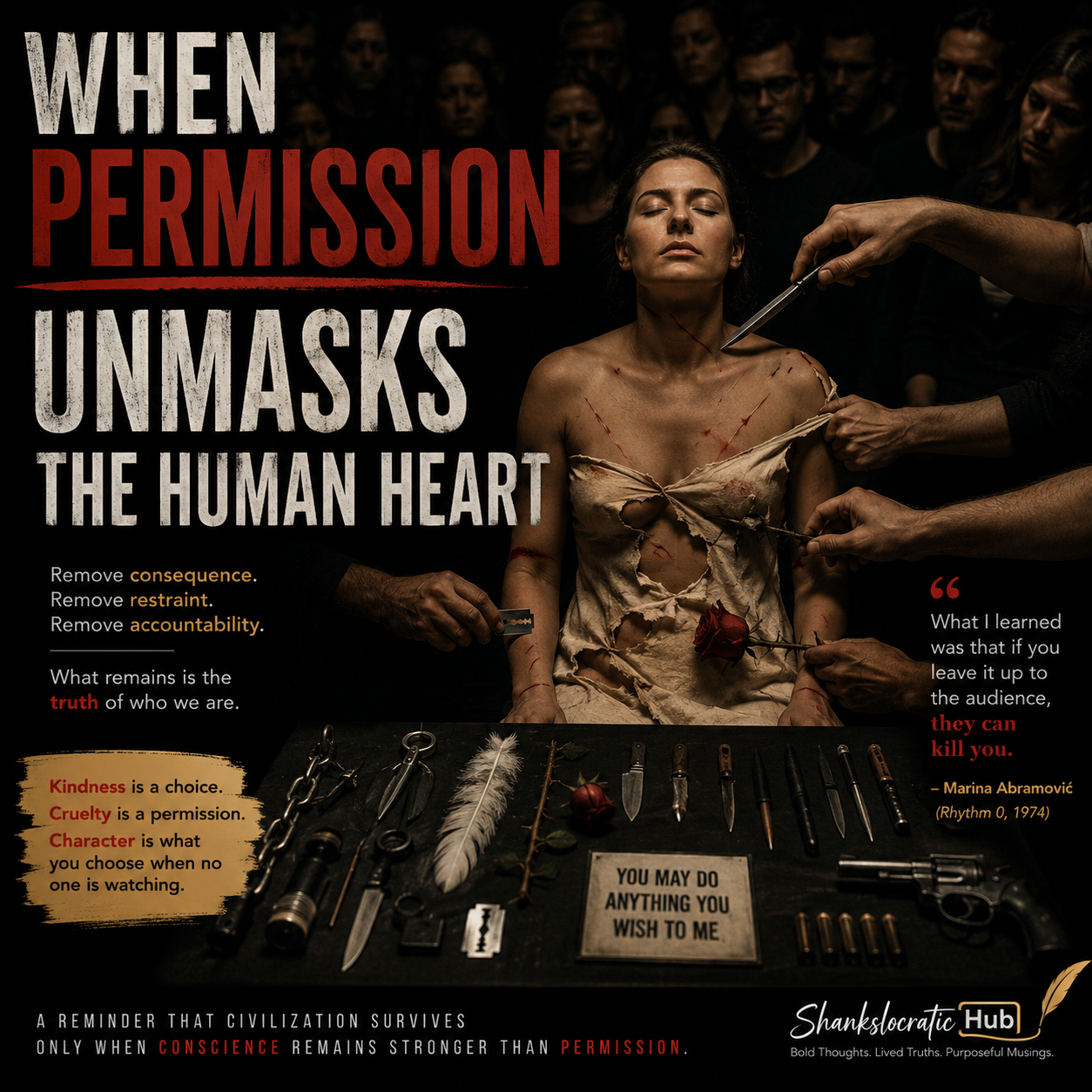
In 1974, Serbian performance artist Marina Abramović conducted one of the most unsettling experiments ever performed on human behaviour.
For six hours, she stood completely motionless before an audience with seventy-two objects laid on a table. Some were harmless—a rose, a feather, a piece of bread. Others were instruments of pain: razor blades, knives, chains, and even a loaded gun. A simple notice informed the audience that they could use any of the objects on her in whatever manner they chose, while she accepted full responsibility for whatever happened.
At first, people behaved as society expects them to. Some offered flowers. Others kissed her. The atmosphere resembled curiosity wrapped in kindness.
Then something shifted.
Someone cut her clothing. Another pressed rose thorns into her stomach. Razor blades found her skin. She was slapped, violated, humiliated, and treated less like a person than a canvas upon which strangers could project their darkest impulses. By the final hours, one participant reportedly held the loaded gun to her head while another intervened to prevent an irreversible tragedy.
When the performance ended, Abramović did something profoundly simple.
She began to walk.
Suddenly, the audience scattered. Many avoided her gaze. Others hurried away, unwilling to confront the woman they had spent six hours reducing to an object.
The experiment had ended.
Their conscience had returned.
The temptation is to dismiss this episode as an odd chapter in the history of performance art. That would be a mistake. Rhythm 0 was never merely about art. It exposed an uncomfortable truth about humanity: the distance between civility and cruelty is often much shorter than we imagine.
Civilisation likes to believe that goodness is our natural state. Yet history repeatedly tells a more complicated story.
The Holocaust was not executed solely by fanatics. The Rwandan genocide did not involve only lifelong murderers. Public lynchings, ethnic cleansing, torture, cyberbullying, cult violence, and mob justice have frequently depended upon ordinary people doing extraordinary harm under extraordinary circumstances.
Psychologists have long studied this phenomenon. When responsibility is dispersed among many people, individual restraint weakens. When authority grants permission, conscience grows quieter. When victims become anonymous, empathy begins to disappear.
The tragedy is not that human beings are capable of evil. That has never been in doubt.
The tragedy is how easily circumstances can persuade otherwise decent people to outsource their moral judgment.
This is why crowds deserve our caution.
Crowds amplify emotions while diluting responsibility. They can inspire heroism, but they can also legitimise cruelty. Within a crowd, actions that would horrify us in solitude suddenly become easier because everyone else appears to be doing the same.
The digital age has only expanded the audience.
Every day, strangers participate in public humiliation with a single comment, repost, or anonymous message. Careers are destroyed before facts are verified. Children become targets of coordinated bullying. Rumours spread faster than corrections. Behind a screen, another human being slowly becomes a username rather than a neighbour.
Technology has changed the medium.
Human nature has changed far less.
Perhaps the most disturbing lesson from Rhythm 0 is that the audience did not begin with violence.
They drifted into it.
Cruelty often arrives incrementally. A joke becomes ridicule. Ridicule becomes harassment. Harassment becomes abuse. Each step feels only slightly worse than the one before it, making the next step easier still.
This gradual erosion of conscience explains why societies rarely collapse overnight. Moral decay usually advances by small permissions repeatedly granted.
Fortunately, the opposite is equally true.
Character is also built incrementally.
Every decision to defend the vulnerable instead of exploiting them strengthens conscience. Every refusal to join a mob preserves individuality. Every act of compassion resists the subtle pull of dehumanization.
The world often celebrates intelligence, ambition, influence, and strength. Yet none of these qualities guarantees goodness. History has produced brilliant villains, ambitious tyrants, influential propagandists, and powerful oppressors.
What civilisation requires most is not merely intelligent people but morally anchored ones—individuals who remain humane even when cruelty is permitted, popular, or profitable.
When Abramović later reflected on the performance, she remarked, "What I learned was that if you leave it up to the audience, they can kill you."
The statement was not merely about an audience inside a gallery.
It was about every society that forgets the value of a single human life.
Perhaps the greatest safeguard against becoming part of such a crowd is to ask ourselves one uncomfortable question whenever everyone seems to be moving in the same direction:
If there were no applause, no anonymity, and no one else to blame, would I still choose this action?
The answer may reveal not only who we are, but who we are becoming.




28 comments
Log in to join the conversationWhat a story
1
Got it💯💯💯
People love to think they'd be the hero in history. Reality says many would simply follow the crowd
Omo... this one heavy pass Monday morning
The internet gives people masks. Some wear them to become heroes, others become villains
This is why I don't always trust trends. Not everything popular is right
If everyone around you is doing wrong, can you still stand alone? That's the real test.
One person started. Others simply followed. That's how history repeats itself
No be everybody wey wear suit get conscience.
Mob mentality has destroyed more lives than many people realize.
Omo, humans dey fear me pass horror movies
Kindness is easy when it costs nothing. Character is tested when cruelty is allowed."
Has kindness ever cost nothing???
The audience ran because guilt finally entered the chat
This gave me goosebumps. Human beings are far more complicated than we admit
Social media na modern version of this experiment. Some people dey type things wey dem no fit say face to face
😂😂
No lies
The person we become when nobody is watching is our real identity
Its not easy sha
Rhythm should be taught in schools. It explains human psychology better than many textbooks
Na why dem talk say power corrupts. Give person small permission, you fit no recognize am again."
This applies to everyone
The scary part isn't that monsters exist. It's that sometimes they look exactly like us.
No one can save humanity from their violent nature