
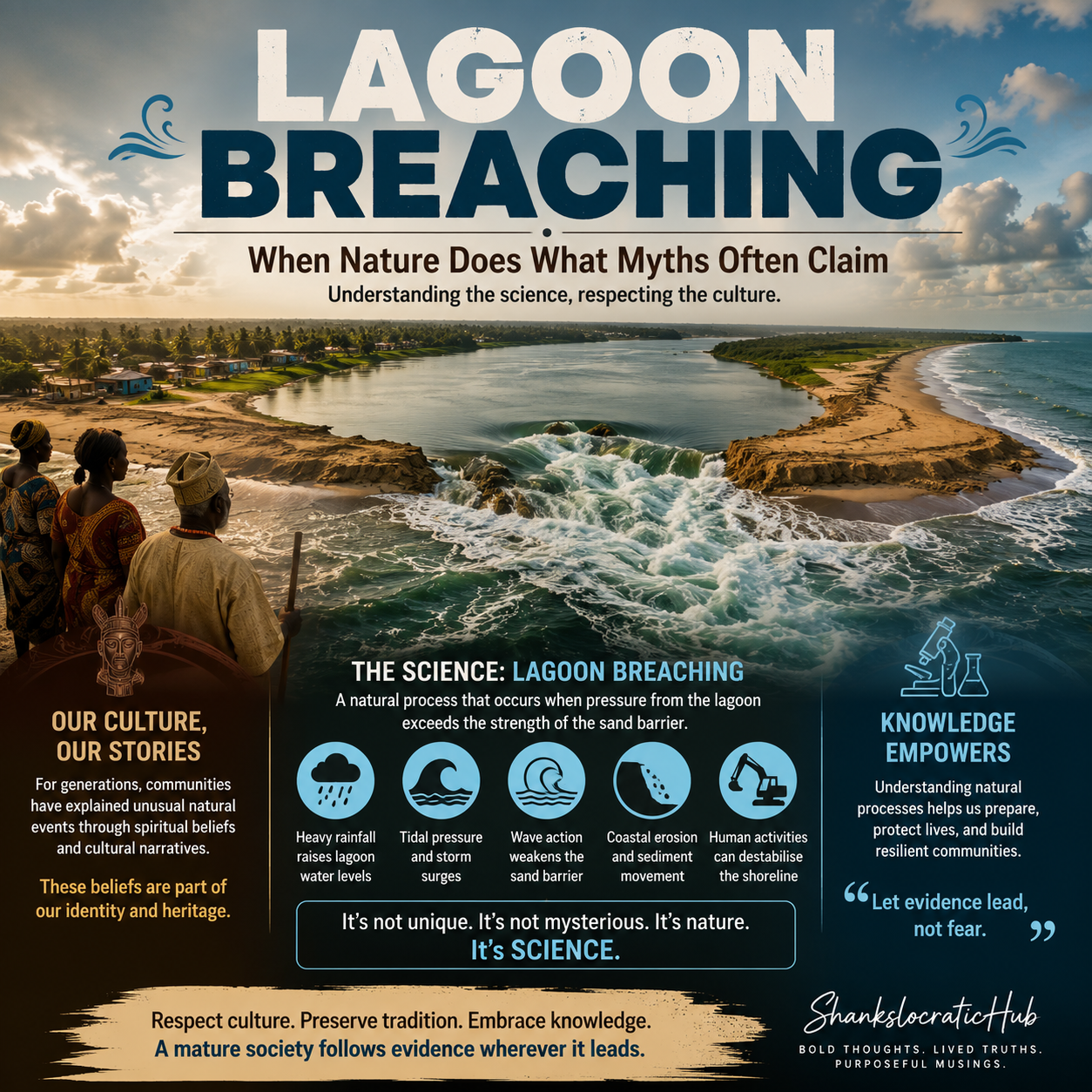
Lagoon Breaching: When Nature Does What Myths Often Claim
The recent lagoon breaching around Badagry, particularly near Kweme Kingdom, has generated many explanations. Some have attributed it to Alujonu, while others have linked it to the Wule deity of the land. Such beliefs are understandable within the cultural framework of many African communities, where unusual natural events are often interpreted through spiritual lenses.
Whether or not one believes in the existence of spiritual forces is a separate question. The issue here is that lagoon breaching itself is a well-documented coastal process with established scientific explanations.
However, while Africa has rich spiritual traditions that deserve respect, not every extraordinary event has a supernatural cause. Some have well-established scientific explanations that have been studied across the world.
One such phenomenon is lagoon breaching.
What is Lagoon Breaching?
Lagoon breaching occurs when a sand barrier separating a lagoon from the sea is broken naturally or artificially, creating a temporary or permanent channel between both water bodies.
This happens because of a combination of factors, including:
- Rising water levels inside the lagoon after prolonged rainfall.
- Strong tidal pressure and storm surges from the sea.
- Wave action that continually weakens sandy barriers.
- Coastal erosion.
- Human activities such as dredging, sand mining and construction that destabilise the shoreline.
When the pressure exceeds what the sand barrier can withstand, it eventually gives way. The result is often dramatic: torrents of water rushing through a newly formed opening.
To an observer unfamiliar with coastal processes, such an event may appear mysterious. To coastal geomorphologists and hydrologists, it is an expected natural process.
Has This Happened Before?
Absolutely.
1. Lagos Coast, Nigeria
Researchers have documented repeated shoreline changes along the Lagos coast caused by coastal erosion, sediment movement, rising sea levels and human activities. These studies show that Nigeria's barrier beaches and lagoons are dynamic systems that naturally evolve over time.
2. Lake St Lucia, South Africa
The mouth of Lake St Lucia has repeatedly opened and closed naturally for centuries. Historical records dating back to the nineteenth century describe numerous breaching events driven by rainfall, river discharge and ocean conditions rather than supernatural causes.
3. Chilika Lagoon, India
One of the world's largest coastal lagoons experienced severe ecological decline until a new sea mouth naturally developed (later assisted through engineering in 2000). The new breach restored water exchange and significantly improved the lagoon's ecosystem.
4. Waituna Lagoon, New Zealand
Because natural breaching periodically occurs, environmental managers sometimes even create controlled openings when water levels become dangerously high. Rather than seeing breaching as an abnormal event, it is treated as part of the lagoon's natural cycle.
5. ICOLL Systems, Australia
Australia's Intermittently Closed and Open Lakes and Lagoons (ICOLLs) are famous precisely because they repeatedly close and breach. Entire scientific management frameworks exist around predicting these events.
These examples demonstrate that lagoon breaching is neither unique to Badagry nor unprecedented in coastal environments.
Why the Badagry Incident Should Not Surprise Scientists
The Badagry coastline forms part of the Gulf of Guinea, an area known for:
- Active coastal erosion.
- Strong Atlantic wave energy.
- Seasonal flooding.
- Continuous sediment movement.
- Increasing impacts of climate change.
Given these conditions, breaching is a recognised geomorphological process. Rather than asking "Which spirit opened the lagoon?", science asks:
- How much rainfall occurred?
- What was the lagoon's water level?
- How high were the tides?
- Was there recent erosion?
- Did human activities weaken the barrier?
These questions produce measurable, testable answers.
Does This Mean Spiritual Beliefs Are False?
No.
Recognising the science behind lagoon breaching is not the same as denying African spirituality or religious beliefs.
Many people of faith—including scientists—believe God created the natural laws governing the earth. Likewise, many Africans continue to value their cultural heritage.
The important distinction is this:
Where natural processes have been clearly demonstrated, they should be our first explanation—not our last resort after exhausting supernatural ones.
Doing so can distract from addressing the real issues, such as poor coastal planning, unchecked dredging, environmental degradation and climate change.
Knowledge Does Not Destroy Culture
Understanding lightning did not eliminate our appreciation of thunder.
Understanding eclipses did not erase our cultures.
Understanding diseases did not make traditional societies less African.
Likewise, understanding lagoon breaching does not diminish our heritage. Rather, it equips communities to prepare for future events, protect lives and make better environmental decisions.
Culture gives us identity.
Science helps us understand how nature works.
The two do not always have to be in conflict.
The recent Badagry lagoon breaching should therefore be understood, based on available evidence, as a coastal geomorphological event rather than immediate proof of supernatural intervention.
Respect culture. Preserve tradition. But where science has provided verifiable explanations, let us embrace knowledge. An informed society is better equipped to protect both its people and its heritage.
A mature society is one that knows when to preserve its traditions, when to question its assumptions, and when to follow the evidence wherever it leads.
General References
- Journal of African Earth Sciences. Vulnerability of the Nigerian Coast: An Insight into Sea Level Rise Owing to Climate Change and Anthropogenic Activities (2017).
- Coastal geomorphology literature on barrier-lagoon systems and inlet breaching.
- Ramsar Convention documentation on coastal lagoons.
- Case studies on Lake St Lucia (South Africa), Chilika Lagoon (India), Waituna Lagoon (New Zealand) and Australian ICOLL systems.




6 comments
Log in to join the conversationYou serve some accolades👌👏👏
Interesting to read. You’ve said it all
Yes, knowledge does not destroy our culture. You write so well, you think well. I love your posts
Knowles, culture, belief are all connected in similar ways. It’s just like art and science
Such History
This is a very long story but it’s interesting