
Retrospection of My Childhood Days
It's funny how time slips through our fingers. One day you're racing barefoot across the compound; the next, you're wondering when childhood quietly packed its bags and left without saying goodbye.
Looking back, I realize something profound: the hours I thought I was "wasting" were never wasted at all. They became investments in joy, friendship, imagination, resilience, and memories that have outlived every gadget I've ever owned.
Sometimes I wish I'd known I was living through the "good old days" while they were still unfolding.
For those of us who grew up in Nigeria during the 1990s, childhood wasn't merely a stage of life—it was an entire civilization.
The School Assembly Rituals
Every school morning began with order. We lined up according to our height—our famous "gogolarity" arrangement. If you were among the shortest, congratulations; you occupied the front row. I proudly belonged there.
Before classes, the Headmaster or Headmistress, alongside the teachers, inspected our uniforms, nails, haircuts, socks, shoes, and overall neatness. Back then, those inspections felt like military parades. Today, they feel like love disguised as discipline.
Lunch Break Was an Adventure
Today's children may never understand how much happiness a few naira could buy.
The school kiosk was paradise: Nasco, Okin, Short Cake and Vanilla biscuits, Trebor, Butter Mint, and those legendary iced coloured waters—"lolly"—sealed inside transparent nylon sachets.
Nothing tasted better after a football match under the afternoon sun.
Then came the snacks every Nigerian child knew: Sweet Alagbon, Goody-Goody, "Fi sibi jẹ," and Choko Milo.
My favourite school lunch was simply bread and butter. And yes, I was that "nice boy" who gave his biscuits to the girls.
No regrets.
The Books That Raised Us
Long before tablets, smartphones and learning apps, our closest companions were books: Lantern Qualitative and Verbal Reasoning, Understanding Mathematics, Larcombe's Primary Mathematics, the Aláwìíyé series by J. F. Odunjo, Taiwo àti Kéhìndé by T. T. Solaru, Ade, Our Little Naughty Brother, Akin Goes to School, The Hunter and the Hen, Ali and Simbi, Tales from the Arabian Nights, Evans Bible Knowledge, Stories of God's People, the Oxford Dictionary with that unforgettable head illustration on the cover, Ralia the Sugar Girl, The Incorruptible Judge, and countless others.
Those books did more than prepare us for examinations. They taught us how to think.
When One Naira Was Real Money
There was a time when ₦1 actually meant something.
Groundnut and Choko Milo cost just 50 kobo. One naira's worth of round kulikuli—"Ori Abacha"—was enough to prepare a satisfying bowl of garri. A few coins could make you feel like the richest child in the neighbourhood.
Back then, inflation hadn't yet stolen the purchasing power of childhood.
Games That Needed No Batteries
Our playground wasn't hidden behind a screen. It was the street, the compound, and the open field—before the first wave of electronic brick games arrived in the mid-1990s.
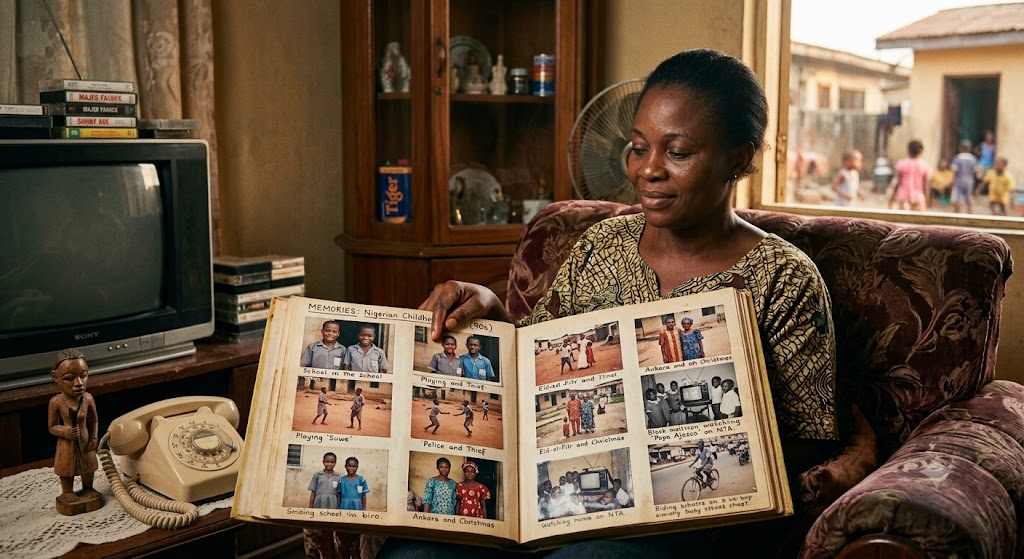
We played Messing Game, Who's in the Garden?, Police and Thief (Doggy Fire), Mama and Papa, Tinco-Tinco, Change Your Style, Ten-Ten, Pseudo Wrestling, and Skipping.
Sometimes we built houses with sand and defended them like architects protecting masterpieces.
Nobody needed Wi-Fi.
Our imagination supplied everything.
Engineering Before We Knew the Word
Nigerian children have always been inventors.
We flew homemade kites, although mine rarely made it beyond our compound. Paint bucket covers became tyres—mine came from a Family Size Custard bucket. Our fathers' copper wire hangers became steering wheels. Rubber bands were priceless assets. We built entire worlds from things adults considered useless.
Creativity wasn't taught; it was simply how we lived.
Cartoons That Defined Saturday Mornings
Weekend mornings belonged to television—not smart TVs or streaming platforms, but our faithful black-and-white television.
We watched Voltron: Defender of the Universe, Power Rangers, Teenage Mutant Ninja Turtles, Spotty, Jumbo, The Magic School Bus, and Scooby-Doo.
Those stories reflected worlds far removed from everyday Nigerian life, yet somehow became part of ours. Every episode was an event. Missing one meant waiting another week. Patience came naturally because there was no rewind button, on-demand streaming, or binge-watching.
A Childhood Without Notifications
Looking back, I don't think what made the 90s magical was merely the cartoons, biscuits or games.
It was the rhythm of life.
Nobody measured their worth by likes or followers. Friendships happened face-to-face. Family conversations unfolded around the dining table. Photographs were printed and preserved in albums. Music travelled through cassette tapes and radio dedications, while films were watched on owned or borrowed VHS tapes.
If you wanted to see your friend, you walked to their house. If you were bored, you invented a game.
And somehow, those ordinary moments became extraordinary memories.
What We Should Preserve
I don't believe every generation must relive the 1990s exactly as we did.
Times change. Technology changes. Society changes.
But some things should never change.
Children still deserve afternoons spent outdoors, friendships beyond screens, boredom that awakens creativity, communities where neighbours know one another, and memories that cannot be measured by battery percentage.
Perhaps we cannot bring back the 90s. But we can preserve its spirit: the freedom to imagine, the simplicity of finding joy in ordinary things, and the gift of growing up without life constantly demanding our attention.
More than the toys, the snacks or the cartoons, that is what made our childhood unforgettable.
And maybe... just maybe... that's why so many of us still smile whenever someone asks,
"Do you remember those days?"
Because we do.
And what beautiful days they were.
How I wish I could draw back the hands of time...




17 comments
Log in to join the conversationI have one of these too
Nostalgic
Gen Z go think say na fable
We used to walk to our friends' houses without calling first, and somehow everyone was home. Simpler times.
One naira actually had value back then. Today's kids won't believe the stories we tell them. 😭
What a nostalgia! Good old days
No Wi-Fi, no smartphones, yet we were never bored. Our imagination did all the work.
Bread and butter, Choko Milo, and iced lolly😂😂😂😂😂
Reading this felt like watching my entire childhood flash baack
Childhood in the 90s was different. We had little, but somehow we had everything that mattered.
Omo we no de taya to play at all
The moment I saw "gogolarity," I knew this post was written by someone who lived through the 90s. 😂
All of una don old for here ohh
This took me straight back to my childhood. Those days were truly priceless. ❤️
Back then we wanted to grow up, now we want to go back
If you grew up in Nigeria in the 90s, this post isn't just a story it's a part of your life. Those were truly the good old days
No cap