
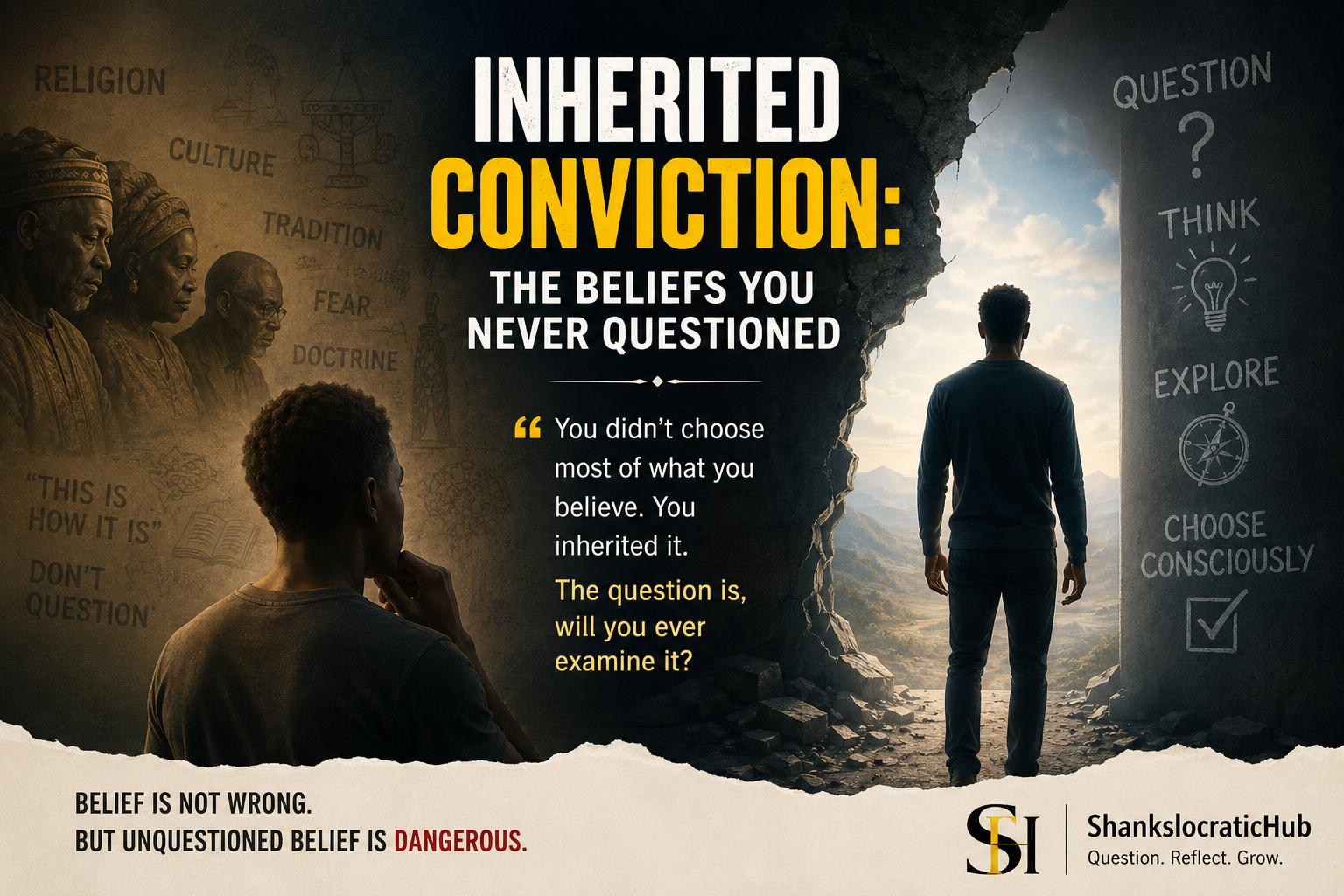
Inherited Conviction: The Beliefs You Never Questioned
You call it belief.
But here's an uncomfortable possibility: had you been born somewhere else, you might defend an entirely different truth with the very same certainty.
That thought should make us pause.
Most of what we call belief was never truly chosen, it was received. Long before we learned to question, entire frameworks of truth were handed to us through family, culture, geography, and, sometimes, fear. We didn't arrive at our beliefs; we grew up inside them.
Beliefs are often inherited the way accents are, not because we carefully evaluated them, but because they surrounded us before we knew we had a choice.
What passes for conviction is often continuity. People frequently mistake familiarity for certainty. They echo the language they were taught, defend the norms they were raised around, and uphold ideas they inherited without ever truly interrogating them. Traditions, doctrines, cultural assumptions, and even fears are passed down, rehearsed, and reinforced across generations. Through repetition, what begins as exposure slowly hardens into something that feels deeply personal, not because it has been rigorously examined, but because it has been consistently affirmed.
And then, one day, a question quietly arrives.
Not merely, What do I believe?
But, Where did it come from?
And perhaps more unsettling still:
Who benefits from me never asking?
Religion, spirituality, and ideology are often presented as personal choices. Yet for many of us, they begin as inherited identities long before they become examined convictions.
So consider this carefully:
If you stripped away your upbringing, your environment, and your earliest conditioning, what would your belief look like? Would it still stand, or would you have to build it again from the scratch?
How Belief Takes Hold
From the moment we are born, we are immersed in a system of quiet transmission. Not through formal lessons alone, but through constant observation. We learn from parents, peers, mentors, and authority figures, absorbing not only what they say, but how consistently they live it.
Belief doesn't spread primarily through argument; it spreads through relationship.
In that sense, belief is less like a conclusion we arrive at and more like an environment we grow within.
The patterns are difficult to ignore. People raised within a religious tradition overwhelmingly remain within one, while those raised outside religion are far less likely to adopt it later in life. This isn't primarily driven by evidence or debate. More often, it is driven by sustained exposure.
Yet exposure alone is not enough.
What makes inherited belief endure is lived conviction.
When people don't merely profess what they believe but organize their lives around it; when they sacrifice, remain consistent, and embody their values, the belief gains credibility. A parent who speaks about faith but rarely lives it sends a weak signal. A parent whose daily life reflects that faith communicates something far more compelling.
This helps explain an uncomfortable observation.
Why do we dismiss ancient gods like Zeus as mythology, yet regard the beliefs we inherited as self-evident truth?
No one passionately defends Zeus today, not necessarily because the evidence disappeared, but because the communities that sustained those beliefs did. What changed wasn't simply the arguments, it was the environment.
Beyond family, belief is shaped by visibility. What is common feels natural. What is uncommon feels suspicious, regardless of its merit.
This is why changing belief can be profoundly difficult.
It is rarely just a shift in opinion. It often means risking identity, community, familiarity, and belonging.
It also explains why people who move between cultures sometimes find their convictions shifting, not because truth itself changed, but because the environment reinforcing those convictions did.
Yet we seldom tell ourselves this story.
Instead, we explain our beliefs through logic, books we've read, experiences we've had, and conclusions we've reached. While these certainly matter, they often come later. By adolescence, many people already mirror the worldview of their upbringing, even after encountering alternatives.
The uncomfortable implication is this:
What we often call reasoning is, at least in part, reinforcement.
And this extends far beyond religion.
Our politics, moral instincts, attitudes toward wealth, work, success, relationships, and even our definitions of what is "normal" are profoundly shaped by cultural inheritance.
We do not begin from neutrality.
We begin from somewhere.
The Work of Making Belief Yours
If inherited belief explains how conviction begins, it does not explain how conviction becomes genuinely yours.
That requires something inheritance alone can never provide:
Examination.
Awareness is the beginning.
The person who never examines why they believe what they believe is not truly exercising conviction, they are carrying tradition.
Many inherited beliefs may indeed be true. The point is not that inheritance makes them false; it is that inheritance alone cannot establish their truth.
Real conviction emerges through interrogation. Through the willingness to question what feels obvious. Through the courage to step beyond what has always been reinforced.
Interestingly, people raised between competing belief systems often experience less certainty, not because they necessarily discover perfect answers, but because the signals they receive no longer point in the same direction.
In that space, doubt appears.
And doubt, in this sense, is not always the enemy of truth.
Sometimes, it is the doorway to it.
Conclusion: A Quiet Question
True belief, if it exists at all, does not fear questioning.
It survives it.
We inherit beliefs much as we inherit languages. Neither is chosen. But while a language helps us communicate, a belief shapes how we understand reality. One deserves fluency. The other deserves scrutiny.
At some point, responsibility shifts.
The question is no longer what you were given.
It becomes what you are willing to keep.
And more importantly, what you are willing to question—even when doing so costs you comfort, certainty, or belonging.
Perhaps the true measure of conviction is not how confidently it is defended, but whether it can withstand honest inquiry.
Because truth has nothing to fear from sincere questions. Only inherited certainty does.
— ShankslocraticHub


22 comments
Log in to join the conversationAs you grow older , when you find the answers you'll make your own choice
Hmmm
This is actually true
Now I've grown, it's my choice
The idea that doubt can be a doorway instead of a weakness is powerful.
📌
Makes you realize how much identity is tied to what you were born into.
I like how this doesn’t dismiss belief, it just challenges how blindly we inherit it.
This explains why people defend beliefs so strongly even without ever questioning them deeply.
We really do confuse familiarity with truth more than we admit.
That question “who benefits from me never asking?” is going to stay in my head for a while.
It’s scary how much of what we call “truth” is just repetition from childhood.
💯💯
I’ve never actually stopped to ask myself where my core beliefs even came from until reading this.
Our core beliefs came from what out parents believe in
The part about belief being like an accent is so accurate it’s almost uncomfortable.
Depends on how you see it
This hits hard because most of us really never chose what we believe, we just grew into it.
You all are right
Questioning your beliefs isn't a sign of weak faith or weak conviction, it's a sign that you're taking truth seriously. If a belief is true, honest examination shouldn't diminish it; it should strengthen it.
Having doubt is not a bad thing at all
Inheritance explains where many beliefs begin, not whether they're true or false. The important question isn't, "Was this belief inherited?" but, "Does it still hold up after honest examination?" A belief that survives sincere questioning becomes conviction, not just tradition.