
When Grief Meets Gender: The Danger of Ranking Parental Worth
I came across a post recently that got me thinking. It posed a difficult question: if a child had to lose one parent, would it be "better" for it to be the father because mothers supposedly care more?
I understood where the emotion was coming from, but I also found myself uncomfortable with the conclusion.
The truth is, in many homes, mothers are the primary caregivers. They're often the ones keeping daily life together, offering comfort, managing routines, and providing that constant emotional presence. So it's understandable why many people instinctively feel that losing a mother would shake a child's world more.
But does acknowledging that reality mean a father's loss hurts less?
For me, the answer is no.
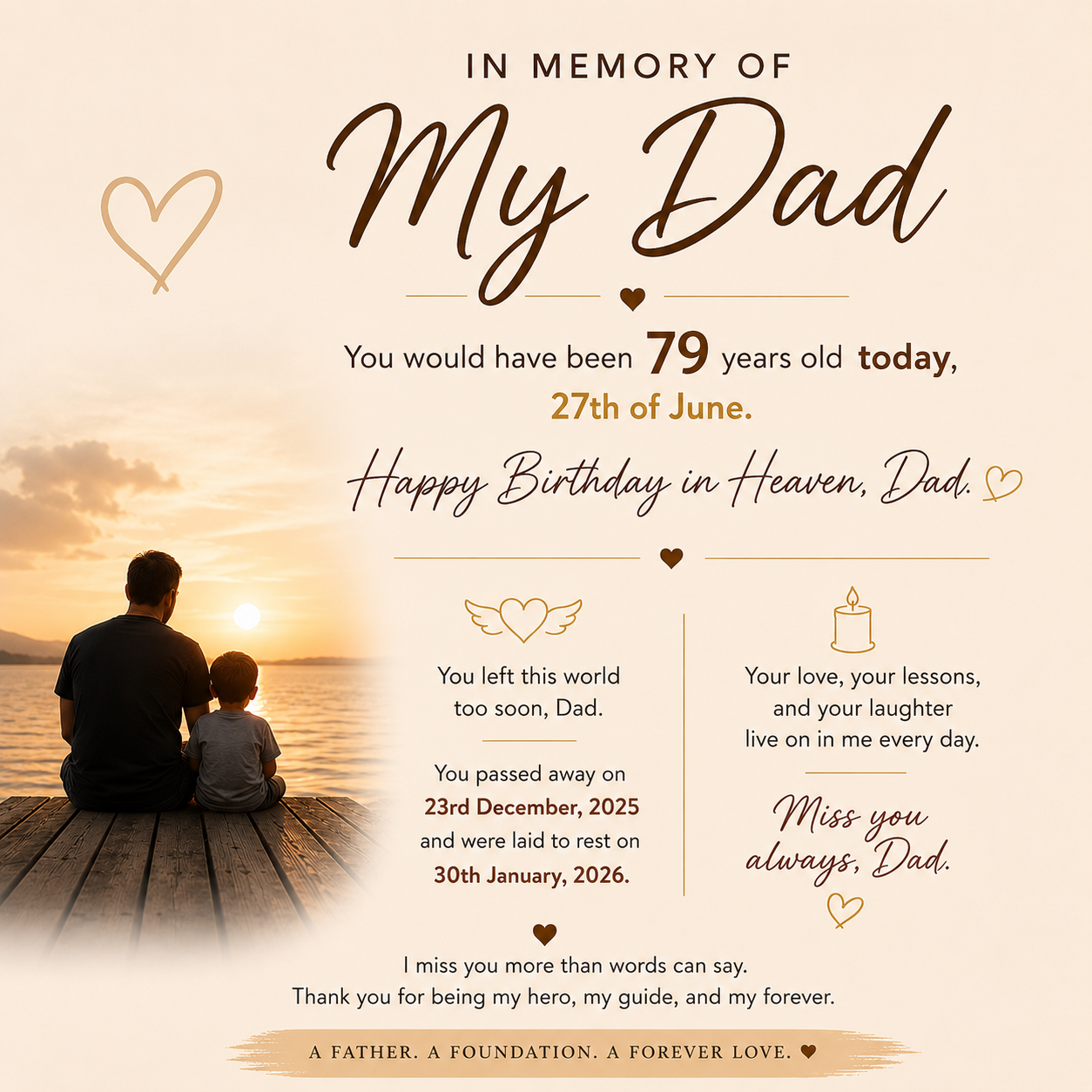
I lost my dad just over six months ago. Growing older has not made losing him any easier. I still feel his absence in ways I never fully anticipated. During the more than two years I helped coordinate his care, I came face to face with just how fragile life really is. My mum undoubtedly carried more of the day-to-day caregiving responsibilities, and I would never diminish that. But losing my dad reminded me that a parent's value cannot be measured only by who did more of the caregiving.
The moment we start framing one parent's death as the "better" option, we've unknowingly begun ranking the value of parents. And that's unfair—not just to fathers who are deeply present in their children's lives, but also to children who still carry the pain of losing their dads.
Every family's story is different.
There are fathers raising children alone. There are stay-at-home dads. There are mothers who are absent. There are grandparents and guardians who step into parental roles. Caregiving isn't determined by gender alone—it's shaped by love, commitment, and presence.
Maybe we're asking the wrong question.
Instead of debating which parent a child could "afford" to lose, perhaps we should be asking how we can reduce preventable parental deaths, strengthen healthcare, and build support systems that help families when tragedy does happen.
Because grief isn't a competition.
The loss of a mother and the loss of a father may not look identical, but neither is a lesser wound. They leave different kinds of emptiness, and both can shape a child's life forever.
Every parent is irreplaceable.
The conversation shouldn't be about choosing who is more expendable. It should be about doing everything we can to keep both parents alive, present, and supported.
This reflection is dedicated to the memory of my dad, who would have turned 79 today. Six months have passed, but the lessons he left behind and the space his absence created remain with me every day.



16 comments
Log in to join the conversationIt shouldn't be a thing of making choices
I love my mom but I can't imagine my life without my dad in it
Lost my dad over 10 years ago, but most of the time i always wonder how life would have been with him around. Both parent are important in a child's life
Please oo everybody is important
interesting
You captured the complexity of family roles so well—love and presence matter more than gendered assumptions.
Grief really isn’t a competition, but people often treat it like one without realizing the harm it causes.
This challenges a lot of unconscious bias people carry about mothers and fathers. Well said.
The part about reducing preventable parental deaths is powerful. That’s where the focus should actually be.
Really sorry about your dad. Six months is still very fresh, and the absence never really disappears, it just changes shape.
The point about every family being different is so important—there’s no universal template for parenting roles anymore.
Losing a parent isn’t something that can be ranked. It reshapes a person’s entire world no matter who it is.
I appreciate how you balanced emotional honesty with realism about caregiving roles without diminishing either parent.
The framing of “which loss is more acceptable” really does miss the point entirely. This hits hard.
You articulated something a lot of people feel but don’t always know how to express. Both parents matter in deeply different but equal ways.
This is such a thoughtful and necessary perspective. Grief shouldn’t be turned into comparisons or “better/worse” losses.