
Eko Wenjele: When Nigerian Hustle Became a Video Game
There's something amusing about Nigerians turning the daily struggle for survival into entertainment. The traffic that tests our patience, the hustle that stretches our creativity, and the economic realities that keep us calculating every naira are finding new life in an unexpected place: browser-based video games.
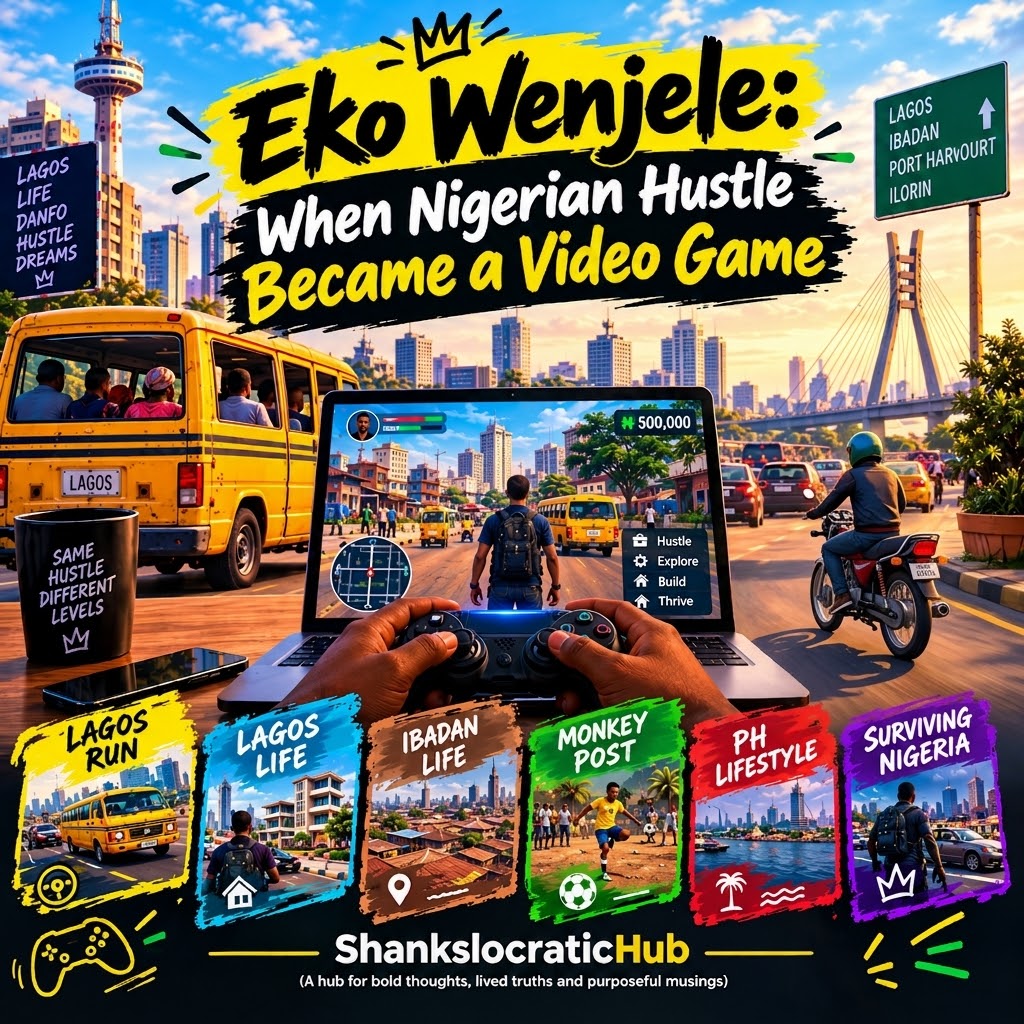
Since late September, a wave of Nigerian city and lifestyle simulations has drawn attention to the possibilities of indigenous game development. One of the early attractions is Lagos Run, created by Opeyemi Adeniran and launched on September 26. The danfo-driving simulator challenges players to navigate Lagos traffic, pick up passengers, and dodge reckless okadas. For anyone who has endured a Lagos commute, the experience probably feels less like fiction and more like unfinished business.
On October 1, Shalom Rayhamen introduced Lagos Life, a broader simulation of urban existence. Players can customise characters, pursue jobs, earn virtual naira, socialise, and explore opportunities in the city. There is even the prospect of acquiring properties in places such as Banana Island, Shonibare, Pinnock Beach, Parkview, and VGC. Who says money no dey Lagos? At least in a simulation, the dream of becoming a property mogul might not require a lifetime of calculations.
The trend extends beyond driving and property ownership. Monkey Post, developed by Yerins Abraham, draws on the nostalgia of Nigerian street football, while PH Lifestyle brings the simulation concept to Port Harcourt. Other projects, including Inside Ilorin and JediJedi, have also appeared in discussions about this growing category of locally inspired games, although their development details and current availability warrant further verification.
Another notable example is Surviving Nigeria, an open-world action game created by Kowa (KOWA with stuff). Inspired by the 3D free-roaming format popularised by Grand Theft Auto, it takes a different approach from lifestyle and commuting simulators, placing greater emphasis on exploration, missions, and action. Together, these projects illustrate how developers are exploring familiar environments and everyday experiences as material for interactive entertainment.
What makes this wave interesting is not simply that the games feature Nigerian settings. Experiences often associated with frustration are being reimagined as challenges players can control, explore, and enjoy. Traffic becomes a test of skill, managing income becomes a virtual balancing act, and familiar neighbourhoods become worlds worth exploring. Everyday Nigerian life supplies both the setting and much of the entertainment.
There is a cultural dimension to this, too. Popular video games have often centred on environments and lifestyles that feel distant from the realities of ordinary Nigerians. Homegrown simulations offer developers an opportunity to put local environments, social habits, humour, and economic pressures at the centre of the experience. The danfo, the roadside football match, the landlord's demands, and the dream of financial independence are not merely background details; they can become the very mechanics that make a game distinctive.
Of course, turning everyday hardship into entertainment does not make the underlying problems any less real. Part of the appeal may be that games offer something real life rarely does: the chance to experiment, make mistakes, and try again without the consequences following you home. There is a peculiar satisfaction in conquering a virtual version of a situation that routinely defeats your patience outside the screen.
Accessibility is another important part of the story. Browser-based games can reduce the friction associated with downloading applications or navigating app stores. A shareable link can bring a game directly to a potential player, making discovery and participation easier. In a country where data costs, device limitations, and access to technology can influence digital habits, that convenience matters. It does not eliminate every technical barrier, but it can widen the doorway.
Getting people to play, however, is only the beginning. Sustaining their interest requires engaging gameplay, reliable performance, regular improvements, and a viable business model. Developers will need to look beyond the initial excitement of going viral, exploring ways to earn revenue without undermining the experience. Optional purchases, advertising, and strategic partnerships may offer possibilities, provided they suit the game and its audience.
The larger opportunity extends beyond gaming. These projects demonstrate how African developers can draw on local experiences to create digital products with wider appeal. Cultural specificity need not be a limitation; when combined with thoughtful design and technical execution, it can become a competitive advantage. The challenge is to turn initial attention into a sustainable creative industry capable of producing more than occasional viral sensations.
And Ibadan? E ma gbagbe wa o!
As an Ibadan indigene, I was already imagining a game where players would navigate the city's familiar streets, find work, pay unpredictable bills, negotiate the landlord's latest announcement, and somehow keep their finances afloat. Some popular areas would provide the setting, with each location bringing its own encounters and opportunities. Naturally, no proper Ibadan simulation would be complete without the temptation of a generous serving of amala with steaming abula soup.
Then came an interesting discovery: Ibadan Life already exists!
Developed by David Oladeji, the game reportedly opened to players on October 5, extending the city-simulation concept beyond Lagos. Its virtual environment incorporates familiar Ibadan locations, including Bodija, Mokola, Dugbe, and Iwo Road, while allowing players to explore aspects of urban life, including land ownership and building a virtual future.
Its emergence reinforces an exciting possibility: Nigeria's cities have distinct identities, local cultures, economic realities, and everyday peculiarities that can inspire very different gaming experiences. Ibadan, with its sprawling geography and distinctive food culture, offers plenty of material for a digital world that feels recognisably its own.
Perhaps the next step is to make these experiences richer, more distinctive, and more sustainable, giving developers room to build games that reflect their communities while attracting players beyond them.
So, Ibadan people, let's talk! If you could influence the next update of Ibadan Life, what would you add: more recognisable landmarks, realistic transport fares, monthly bills, landlord wahala, or an amala-and-abula economy capable of testing your financial discipline?
And be honest, how many virtual days would your salary last before you started looking for another hustle? 😅

20 comments
Log in to join the conversationLagos Run is just my daily commute with a score attached 😂
Lagos has officially turned your daily commute into a side quest! The only difference is that in the game, you get a score for surviving what real life puts you through for free. 🤣🇳🇬
@sodiq I’d love to hear your thoughts on this! What do you think about Nigerian developers turning our everyday realities into interactive gaming experiences? Could this be the beginning of something bigger for Africa’s digital creative industry? 🎮🇳🇬
Dodging okadas as a game mechanic is too real ngl 🫠
If you've ever navigated Lagos traffic, you know dodging okadas is practically a survival skill! They had to make the gameplay authentic somehow. 🇳🇬🤣
I like the way these developers are building from our own stories, not copying GTA 🎯
Exactly! 😂🇳🇬
There's something special about seeing our own stories, streets, and everyday realities inspire game development. We deserve games that feel like home, not just imitations of somewhere else.
That said, some inspirations and adaptations from elsewhere are still worth celebrating. It's all about creating something that resonates with us while appreciating what others have done well.
Banana Island property in a game is the only way I'm affording it 🤧, at least for now 🙂
Banana Island real estate might be beyond our current salary brackets, but at least the game gives us a chance to live the dream! Virtual landlord, real-life hustler. 😅🇳🇬
It is well
Logos life haha
Landlord wahala should be the final boss
Although I haven’t played any of the games but it’s interesting seeing what people have built so far. I’m a huge fan of us building products that reflect our culture and experience, rather than copying foreign styles.
The videos I saw about Lagoslife really gave me some nostalgic memories because of course, I love the Lagos lifestyle especially the commute lol.
That said, creating these games is one thing, improving them to become something that people open everyday for a very long time is another thing.
This is the part I’ve seen a lot of homegrown products struggle. We start well but are not always able to build products that last several years.
Hopefully this is an opportunity for us to do better in this regard and I look forward to seeing some of these projects around in the next 15 years.
Absolutely! Building culturally authentic games is a great start, but you're right that long-term sustainability is the real test. Beyond the initial excitement, developers need consistent updates, engaging gameplay, and business models that keep both the players and the studios invested. Hopefully, these projects will grow into lasting parts of our gaming culture, not just nostalgic snapshots of this era. Imagine what the next generation of Nigerian developers could build on that foundation!
Interesting times
Technologia
Interesting times indeed! Technology is giving us new ways to tell our own stories, preserve our culture, and turn everyday Nigerian experiences into something the world can enjoy. The exciting part is seeing how far we can take it.
Nigeria my country 😂
Naija for life!
I've not even tried any
Na WA for landlorda ooo