
When a “Lethal” Injection Isn’t Lethal: Justice, Failure and the Pain of Waiting
A failed execution raises questions that go far beyond one prisoner’s survival.
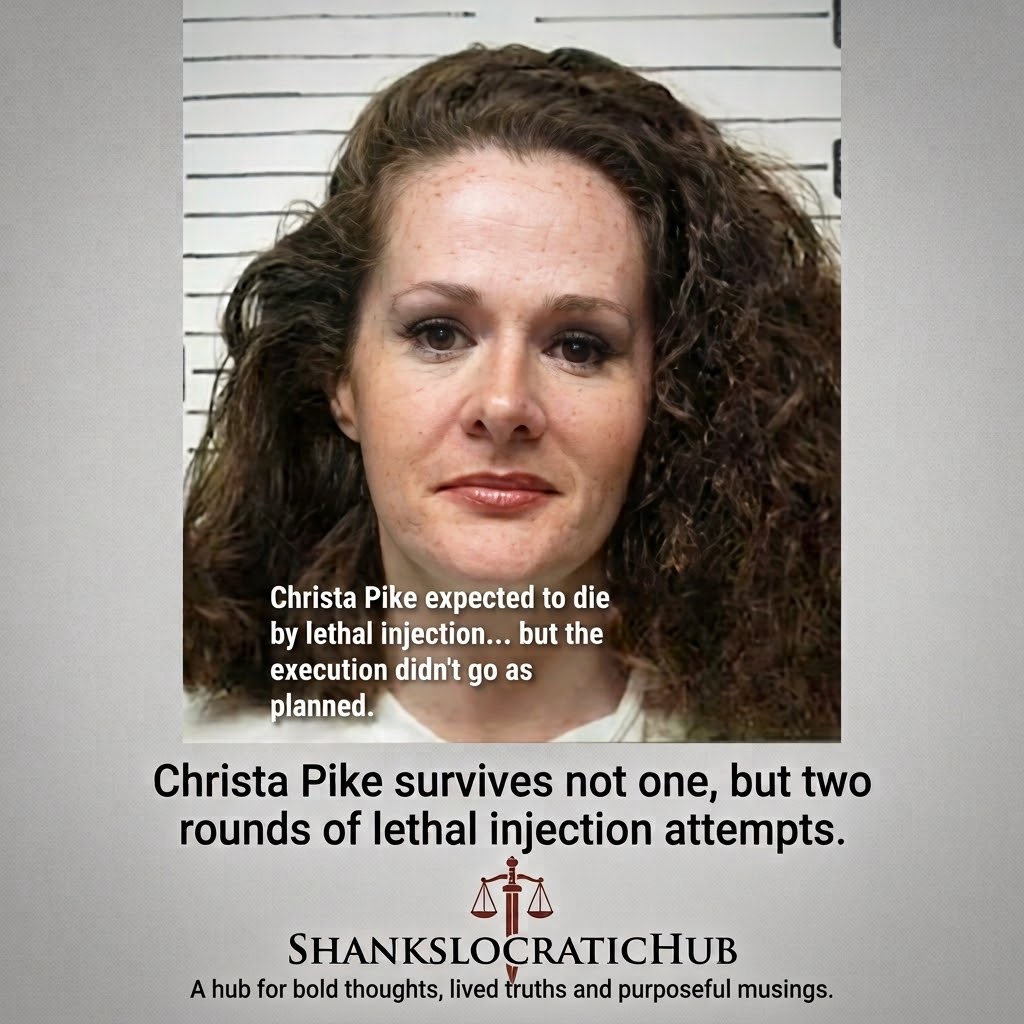
On September 30, 2026, Tennessee attempted to execute Christa Pike by lethal injection. Officials administered two doses of pentobarbital under the state’s execution protocol, but Pike remained alive and was eventually taken to hospital. Her lawyers later said she was in critical condition and receiving lifesaving care.
Pentobarbital is a powerful barbiturate that depresses the central nervous system. At sufficient exposure, it can cause profound respiratory depression, breathing failure and death. So how did someone survive two administrations of a drug intended to kill?
The honest answer is: we do not yet know.
One possibility is a problem with intravenous access. If a catheter fails to remain properly inside a vein, medication can leak into surrounding tissue rather than entering the bloodstream as intended. Pike reportedly complained of arm pain during the procedure, and her lawyers later pointed to blistering and discoloration around the injection area. Those details may be consistent with an IV-delivery problem, but they do not establish that this was what happened. The independent investigation will have to determine whether the failure involved the IV access, equipment, drug administration, the medication itself, or some combination of factors.
That uncertainty is precisely what makes the incident so troubling.
Tennessee says its officials followed every step of the established execution protocol. The state also acknowledged that the protocol did not provide for additional procedures once the permitted administrations had been completed. Governor Bill Lee subsequently ordered an independent investigation and suspended further executions in Tennessee for the rest of 2026.
If an execution protocol is designed to produce an irreversible outcome, what happens when the outcome does not occur?
Was the problem the drug? The equipment? The IV access? The administration? Or the protocol itself?
And yes, one cannot help but notice the grim irony: some execution methods do not depend on successfully delivering a chemical through an intravenous line (winks).
But beneath the irony is a painful reality.
Colleen Slemmer's family had already endured the murder, the trial, the appeals and decades of waiting for the sentence to be carried out. Slemmer's mother was among those who witnessed the failed execution. Instead of witnessing the conclusion she had expected after all those years, she witnessed an execution attempt that failed.
That does not settle the larger argument over capital punishment. It does, however, expose an uncomfortable question about the state's responsibility when it undertakes an irreversible act in the name of justice.
If executions are to continue, the public deserves to know how the system is designed, how its safeguards work, what happens when something goes wrong, and who is accountable when the declared procedure fails.
Because this is bigger than whether one prisoner survived.
It is about what happens when a system designed to deliver a definitive ending instead produces uncertainty, suffering, unanswered questions and another layer of trauma for those already carrying the weight of the original crime.
Justice is supposed to bring an ending.
When the machinery of justice itself breaks down, what exactly has been delivered?





4 comments
Log in to join the conversationFor someone to survive the dose of lethal injection, we have to study her o
If she survived the lethal injection why is she undergoing "lifesaving care" as you said
If it doesn't unalive her immediately as intended and she is in "critical condition" as you said, then let her be in the critical condition until she unalives
Why waste thousands of dollars in medical care for someone on death row
I no know them just dey postpone this woman execution. Since how many years now. Them go dey treat person wey them wan execute for hospital
A little additional context: Christa Pike was 18 when she and two fellow Job Corps students, 17-year-old Tadaryl Shipp and 18-year-old Shadolla Peterson, killed 19-year-old Colleen Slemmer in January 1995. The prosecution linked the killing to a romantic conflict involving Slemmer and Pike’s boyfriend, Shipp.
Pike was sentenced to death. Shipp, who was 17 at the time of the crime, was ineligible for the death penalty and ultimately received a life sentence. Peterson cooperated with the prosecution, testified against Pike and Shipp, and received probation after pleading guilty.
Although all three were involved in the same killing, their ages, individual roles, and cooperation with the prosecution resulted in dramatically different legal outcomes.