
The Mythology of Hustle: How Nigerians Rewrote the Hero's Journey (Part 3)
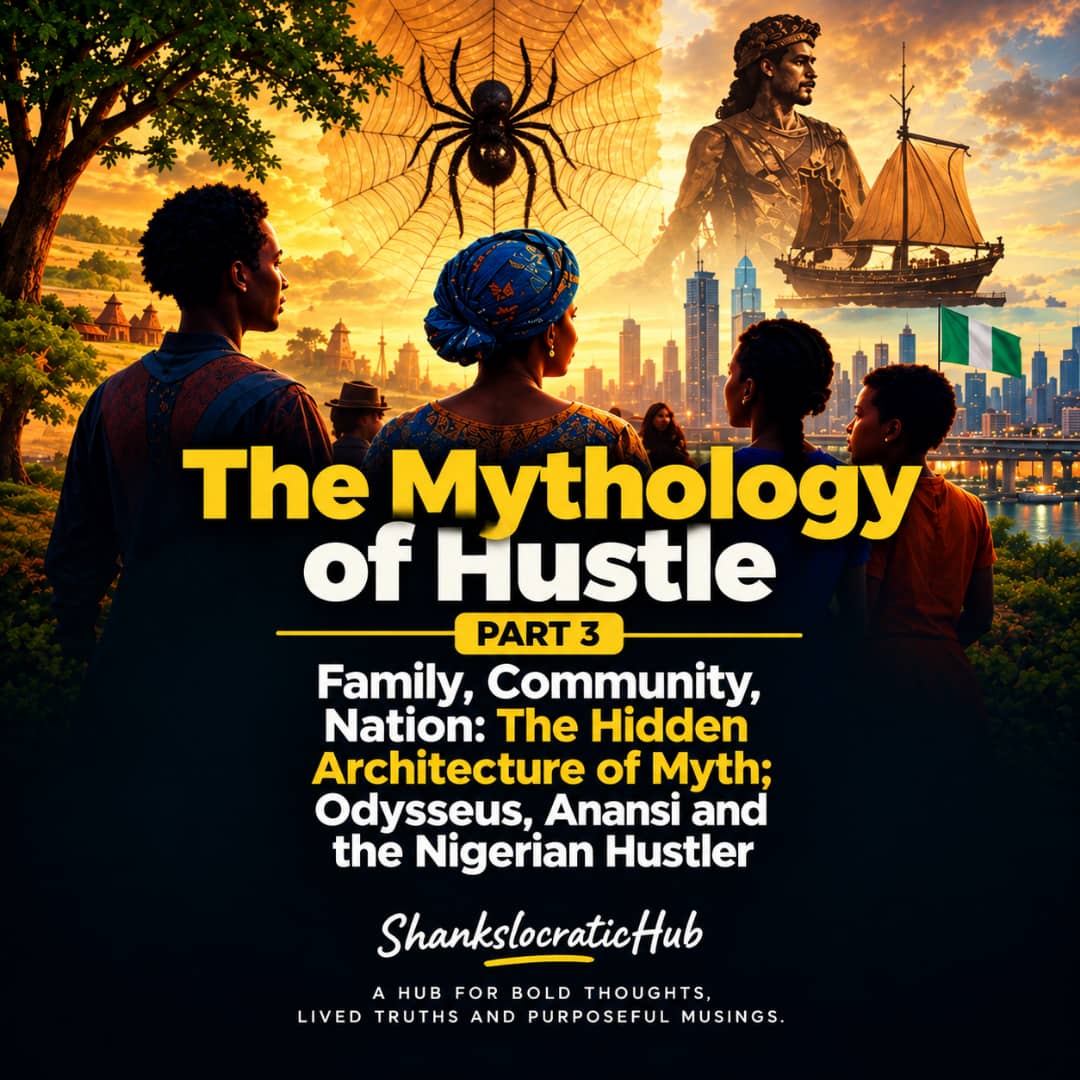
Family, Community, Nation: The Hidden Architecture of Myth
Myth does not begin with grand institutions. It begins quietly within the family unit. Phrases like “we don’t fail in this family,” “our lineage does not suffer disgrace,” or “no one in our bloodline dies young” are not merely cultural expressions, they are identity frameworks.
From an anthropological perspective, such stories function as mechanisms of continuity. Psychologically, they establish internal expectations that influence ambition, fear, and self-concept. At the communal level, these family stories merge into broader cultural expectations. At the national level, they harden into ideology.
In contemporary Nigeria, this ideology manifests as the mythology of hustle - a belief system that defines effort as destiny and perseverance as inevitability. The hustle is not merely economic behaviour; it is a narrative inheritance.
Odysseus, Anansi, and the Nigerian Hustler
Across cultures, mythology has always produced archetypal heroes who endure, adapt, and overcome. Odysseus, in Greek tradition, survives a treacherous odyssey through endurance and tactical brilliance. Anansi, in West African folklore, outsmarts larger predators through wit, improvisation, and strategic cunning.
The Nigerian hustler embodies both traditions. He is expected to endure systemic friction without complaint while maneuvering through institutional roadblocks with sharp wit. Failure is reframed as process; survival is interpreted as progress; and success is seen as destiny fulfilled rather than the alignment of complex structural variables.
This is how mythology sustains itself: by absorbing contradiction without collapsing.




17 comments
Log in to join the conversationTelling people to keep hustling is easier than fixing what's making life hard for them. So we praise the struggle and never question the system behind it.
Spot on. Glorifying the hustle shifts the entire burden onto the individual, letting the institution off the hook completely.
How where u able to write the text in this format
What format are you referring to? I usually write and edit in the Notes app on my phone or tablet, then copy the text into the Quibbles app’s text box for any final edits.
okay
This series is getting deeper with every part. I’m curious to see where you take the mythology of hustle in the next part.
Success isn't always just about working harder. Opportunity, timing, access, environment, and sometimes luck also play major roles.
The connection between personal identity, family expectations, and national culture is something I hadn't really considered before.
I think the interesting question is whether the hustle mentality empowers people or sometimes puts too much responsibility on the individual.
Anansi is actually a great comparison because intelligence and improvisation are just as important as hard work when navigating difficult situations.
The family expectations part is very relatable. A lot of people carry the pressure of making their family proud wherever they go.
This makes me wonder whether our culture celebrates resilience so much that we sometimes overlook the systems making life unnecessarily difficult.
Failure is reframed as process; survival is interpreted as progress” is a powerful way to describe the hustle mentality.
I like the comparison with Odysseus and Anansi. The Nigerian hustler definitely has to combine endurance with creativity.
The idea that hustle is a narrative inheritance is really interesting. Sometimes the pressure to succeed starts from childhood.
We have made a failing system a natural part of life
When dysfunction becomes the baseline, endurance gets disguised as a virtue instead of a warning sign.