
When the Rock Lost Its Keeper: Olumo, Iya Olumo, and the Memory of a People
There is a particular silence when the keeper of a sacred place dies, not total emptiness, but the breathless pause of a storyteller stopped mid-sentence. When Sinatu Aduke Sanni, known as Iya Olumo, died on June 1, 2022, at her home in Itoko, newspapers reported her age as 137. Beyond the headlines, whispers travelled through Egba lands that the monolith shuddered before dawn. Whether the stone moved matters less than the fact that people believed it did. Where history is lived rather than archived, the event and its telling form a single inheritance.
Iya Olumo was never simply an elderly woman associated with a tourist spot; she belonged to an older order of custodianship, serving as a living link to Olumo as far more than stone. During nineteenth-century conflicts, the rock offered refuge to the Egba people, embedding itself in the city's identity - even the name Abeokuta ("under the rock") carries that memory. Her role was never about guiding tourists or reciting dates; to her, Olumo was a sacred presence, sanctuary, and living relationship. Her grandson, Olawale Olaniyan, recalled her decades of service to the rock’s deity and how she politely declined every foreign offer to travel abroad. Her authority was rooted entirely in proximity: daily devotion, observation, and active participation.
Documents record rituals and photographs preserve shrines, but neither transmits the relationship through which a community understands why a place remains sacred. There is specific knowledge in knowing what to say, and another kind in knowing when to speak, where to stand, and which boundaries to respect. Olumo had known other human custodians long before Sinatu such as Chief Sanni Ajimatanikuje, who died in 1956, making her a remarkable link in a much longer chain.
Her death raised a troubling question: what happens when the carrier of a community’s invisible knowledge is gone?
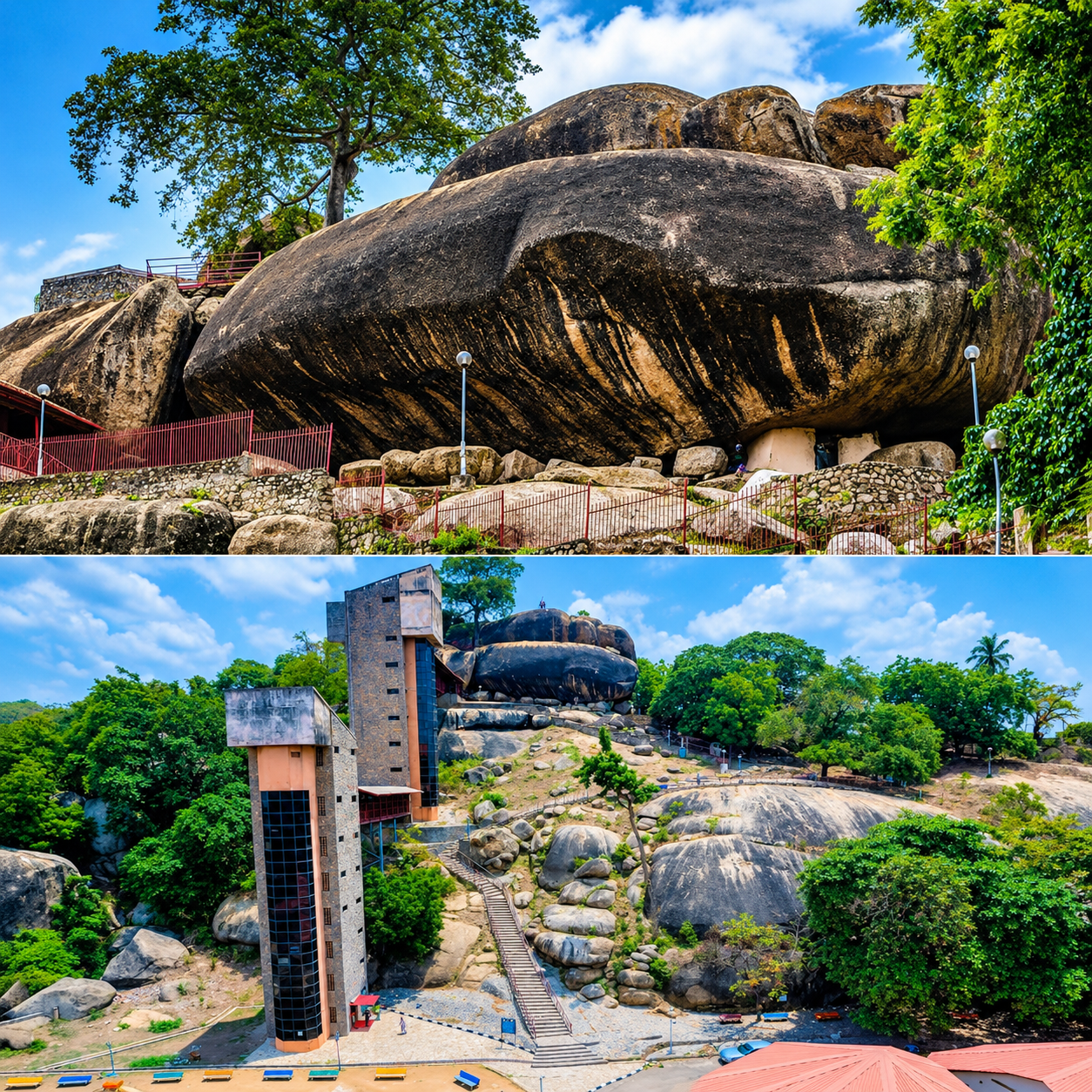
The rock, stairs, elevator, and summit views remain. What is far harder to preserve is the relationship that transforms geology into a sacred landscape. Living traditions rarely vanish overnight; they thin out, fragment, and turn into hollow performances. Yet her story holds a critical complication: her grandson noted she had selected an older woman as her successor six years prior, guided directly by the deity.
While modern succession is loud and public, sacred inheritance moves quietly through years of watching and listening. Today, Olumo holds two parallel worlds: the bustling infrastructure of tourism and the older cultural memory of divine refuge and ancestral continuity. The challenge arises when tourism dominates to the point that the sacred survives merely as aesthetic decoration.
We excel at preserving physical artifacts, but struggle with intangible relationships. You can preserve a site without the worldview that gives it meaning. Sinatu was a bridge between remembered history and commercial tourism, between oral knowledge and recorded heritage. Her burial according to traditional Orisa Egun rites, directly in her room behind Olumo Rock returned her to the very soil around which her life was organized.
Did Olumo lose its keeper, or did the public simply lose sight of where the keeper stands? Beyond ticket booths and smartphone cameras, the older conversation may still be taking place. Living traditions survive not by staying frozen, but by finding new human vessels. Olumo’s story has not ended; the sacred survives because someone, somewhere, still remembers how to listen.



4 comments
Log in to join the conversationI want to be here someday
The rock has an elevator, if you take it, you Miss the fun climbing
Wow I didn't know such a thing about it
@shirley Hi, just a little heads-up that the Olumo piece is now live, as discussed. 😊