
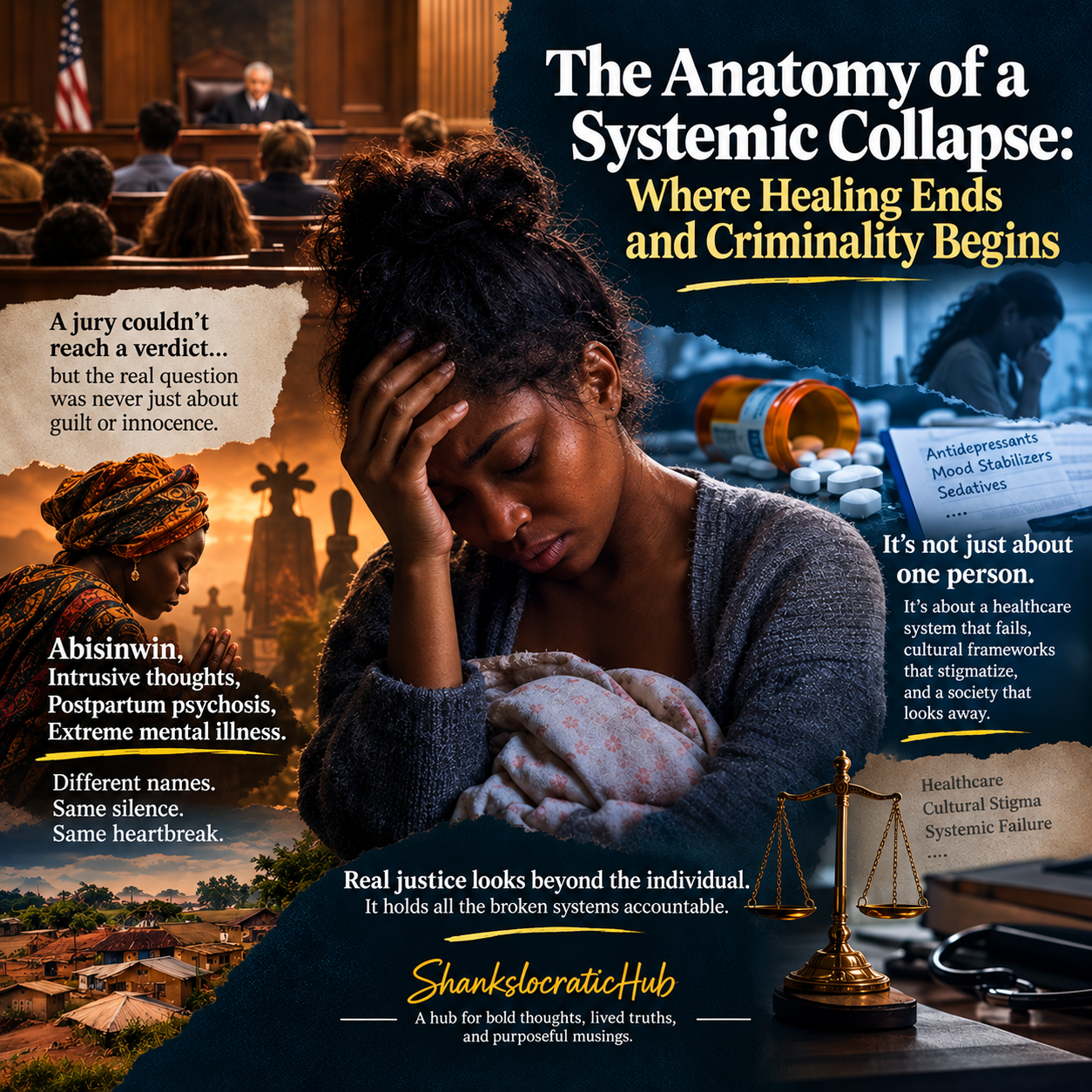
The Anatomy of a Systemic Collapse: Where Healing Ends and Criminality Begins
When a jury could not reach a verdict in the trial of Lindsay Clancy, a mother who killed her three young children during a devastating mental health crisis, the deadlock unsettled many people. Three children were dead. A mother had caused their deaths. Yet the jury could not agree on the degree to which a mind in profound psychiatric collapse could be held criminally responsible.
That discomfort exposes a question larger than one courtroom: where does a medical catastrophe end and criminal guilt begin?
The law prefers clean lines. Guilty or innocent. Intentional or accidental. Rational or irrational. It searches for a conscious decision, a moment in which someone understood what they were doing and chose to do it anyway. Severe mental illness does not always offer such a moment. Sometimes the mind does not merely become distressed; it loses its grip on reality.
Postpartum psychosis makes that boundary especially difficult. A woman can move rapidly from ordinary motherhood into hallucinations, delusions, paranoia, profound confusion or extreme agitation. To everyone around her, the behaviour may seem inexplicable. To her, the distorted reality may feel entirely real.
That is why the timing of a diagnosis should not automatically make it suspect. A broken bone does not become broken when an X-ray reveals it. The examination gives a name to an injury that already existed. A psychiatric diagnosis made after a tragedy can do the same. It may identify a condition that was already reshaping a person's thoughts and behaviour.
This matters because punishment rests partly on the belief that consequences can influence choices. But what happens when illness has severely impaired the capacity to understand reality itself? That does not make the deaths less tragic, nor erase the victims. It forces a harder question: when a mind is catastrophically ill, what exactly is society punishing?
The question becomes more troubling when we examine the treatment that came before the catastrophe.
Psychiatric care can require trial and error. Medication may be adjusted as doctors manage symptoms and side effects. But when care becomes fragmented, a patient can disappear beneath a collection of separate symptoms. One clinician sees anxiety, another depression, another insomnia. Nobody sees the whole person.
Rapid medication changes can sometimes complicate the picture with agitation, restlessness or mood instability. Those symptoms may then be mistaken for deterioration, prompting another intervention. A cycle begins in which every new symptom becomes evidence for another prescription while the underlying crisis continues.
This is not an argument against psychiatric medication. It is an argument against care becoming a revolving door of prescriptions and hand-offs. Someone in severe psychiatric crisis needs observation, continuity, communication between clinicians, appropriate family involvement and rapid specialist care. Sometimes the answer is not another adjustment but a step back to ask what the entire clinical picture is saying.
Systems rarely collapse through one spectacular mistake. More often, they fail through accumulated omissions: a warning missed, a symptom misunderstood, a family uninformed, a clinician working without the full history. By the time tragedy arrives, everyone can point to the final act while overlooking the chain that led there.
And that chain looks different, but painfully familiar, in much of Africa and the Global South.
Nigeria's legal framework recognises circumstances involving mental incapacity, including an insanity defence under Section 28 of the Criminal Code. Yet postpartum psychiatric crises rarely become public courtroom debates here. Often, the breakdown is concealed, misunderstood or redirected long before the criminal justice system becomes involved.
Culture shapes what families believe they are seeing.
Among the Yoruba, àbísínwín can describe mental disturbance or madness associated with the period following childbirth. The concept is significant: it shows that communities have long observed that childbirth can sometimes be followed by profound psychological disturbance. But recognising a phenomenon is not the same as understanding its medical basis.
When severe psychological symptoms are interpreted primarily through spiritual frameworks, a psychiatric emergency may become ancestral punishment, spiritual attack, possession or moral weakness. Families may turn to prayer mountains, faith healers or traditional remedies before seeking psychiatric care. Often, this is not born of cruelty. It is simply the explanatory framework available to them.
But faith becomes dangerous when it becomes the only explanation for a medical emergency.
The Hausa concept of tababbu, broadly associated with mental unbalance, exists within a cultural environment where mental illness can carry stigma. A family afraid of disgrace may hide a struggling mother rather than seek help. Behaviour that should trigger urgent intervention can instead become something to conceal.
Even traditions built around communal care can have blind spots. Omugwo, the Igbo practice of surrounding a new mother with family support, offers something modern healthcare often struggles to provide: community. But if postpartum recovery is understood mainly through physical recuperation, food, rest and infant care, severe psychological deterioration can remain invisible. A woman may be surrounded by people while disappearing inside her own mind.
This is why the answer cannot simply be to dismiss African cultural practices as backward. Traditional structures can provide family, continuity and practical support. The challenge is to make cultural care and medical care capable of recognising one another.
Prayer does not have to compete with psychiatry. Family traditions do not have to disappear for medical understanding to enter the room. But hallucinations, delusions, severe confusion, extreme sleeplessness, suicidal thoughts, violent impulses or dramatic behavioural changes should not be treated exclusively as spiritual problems. In a psychiatric emergency, lost time can become irreversible.
Mental health education must therefore go beyond telling people to seek help. Families need to know what an emergency looks like. A new mother hearing voices is not necessarily possessed. A woman developing bizarre beliefs after childbirth may not simply be misbehaving. Severe agitation, paranoia, confusion and dramatic behavioural changes can signal a crisis requiring urgent medical attention.
The earlier that distinction becomes culturally understood, the greater the possibility of intervention before catastrophe.
There is also a temptation, after tragedy, to place its entire weight on one person. It gives horror a simple shape: one perpetrator, one punishment, one comforting belief that removing the individual makes everyone safe.
But systemic failures rarely have one face.
If someone in psychiatric crisis was failed by multiple layers of protection, then the final act cannot be the only question. What did the healthcare system see? What did it miss? Was treatment adequately monitored? Did clinicians communicate? Did the family understand the warning signs? Did stigma delay intervention? Did cultural assumptions turn a medical emergency into a spiritual mystery?
These questions do not erase individual responsibility. They make accountability more complete.
We are comfortable accepting that disease can alter the body. A seizure is not a choice. A stroke can destroy speech or movement. Neurological injury can radically alter behaviour. Yet when the organ affected is the brain, and the symptoms involve thought, perception or judgment, we are strangely quick to turn illness into morality.
Mental illness does not make every harmful act harmless, and a diagnosis cannot automatically erase responsibility. But neither should a devastating act be examined without asking whether the mind that produced it was functioning normally.
Real justice requires both compassion and accountability. It requires us to honour victims without reducing the person who caused their deaths to a convenient monster. It requires us to protect society without pretending that punishment is the only meaningful response to every form of human brokenness.
Most importantly, it requires us to examine the systems surrounding the individual: the healthcare system that may have failed to connect the dots, the family that may not have recognised the warning signs, the culture that may have taught everyone to hide psychiatric suffering, and the society that may have noticed something was wrong without knowing what to do.
Systemic collapse rarely announces itself. It gathers quietly through every warning ignored, every symptom misunderstood and every opportunity for intervention that slips away.
Then tragedy arrives, and everyone searches for the moment when one person crossed the line.
Perhaps we should also ask how many failures stood behind that line and why nobody moved before it was too late.
Because sometimes the most difficult question is not where healing ends and criminality begins.
It is how much suffering had to accumulate before anyone noticed that healing had already ended.



4 comments
Log in to join the conversationI always say we all have some mental issues of some kind
Man, I don't even know what is fair regarding this case
👏👏👏👏❤️
Different attitude is what we all get