
Beyond Folklore: How Yoruba Proverbs and Ifá Preserve a Living Philosophy (5)
V. Can Destiny Be Changed?
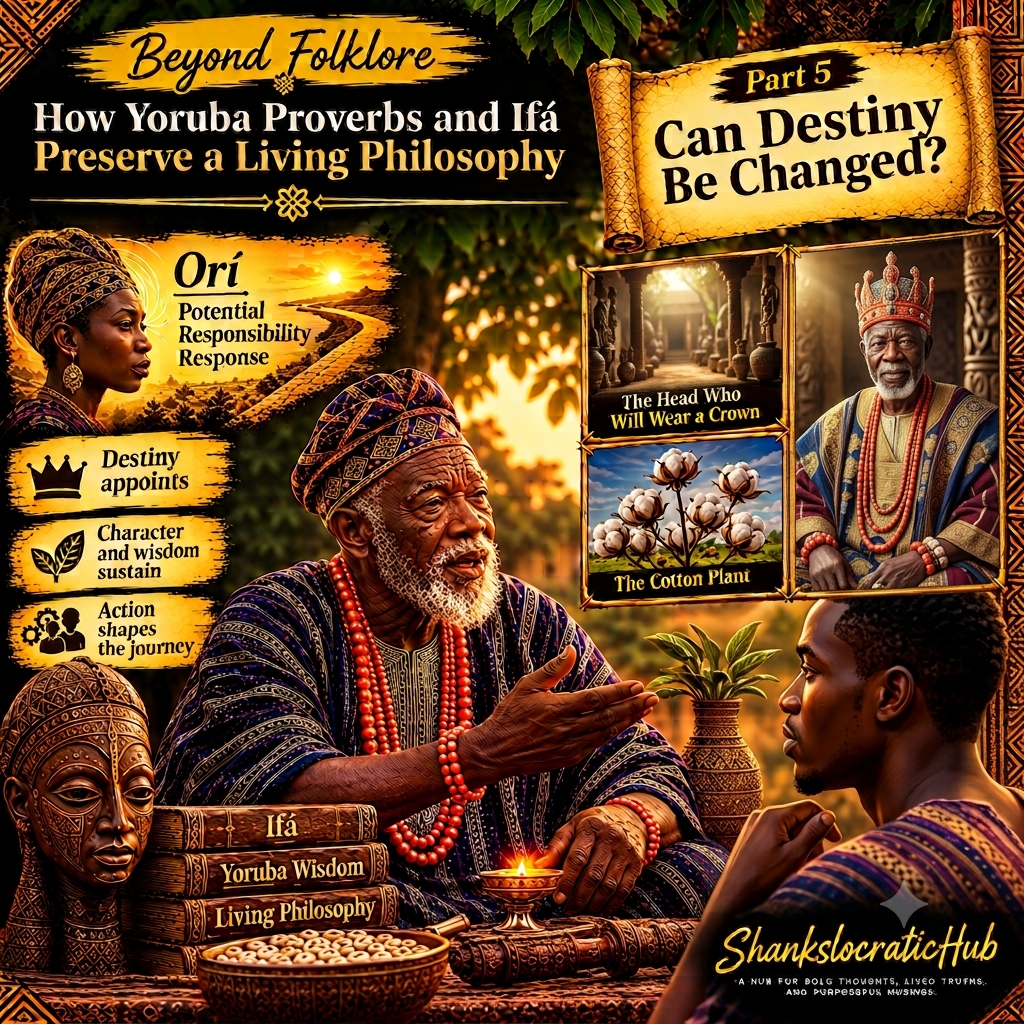
If one Yorùbá concept has suffered widespread misunderstanding, it is Orí. Too often reduced to a flat, mechanical "destiny," it is mistakenly imagined as an unalterable script imposed from birth to death. Within Yorùbá cosmology, however, Orí is far more than the physical head. It is Orí-inú - the "inner head" which encapsulates individuality, spiritual potential, and one's active trajectory through life.
Scholars like Rowland Abiodun place Orí-inú at the core of Yoruba metaphysics, showing how it resists simple fatalism. Similarly, Wande Abimbola’s work on Ifá literature demonstrates that while potential is allotted, its realization depends entirely on conduct, sacrifice, wisdom, and circumstance. This essential tension is reflected in the famous saying: Orí la bá bọ̀, ká f'orìṣà sílẹ̀ ("It is the Orí we ought to worship, leaving other deities aside"). Rather than rejecting the divine order, this maxim elevates personal Orí as the ultimate negotiator of human fate. The core philosophical question is not whether destiny exists, but whether destiny eliminates personal responsibility.
The Ifá corpus refutes passive fatalism through four central narratives:
The Head Who Will Wear a Crown: A head destined for royalty is chosen before birth, establishing the reality of prenatal allotment. Yet upon entering the world, the prospective king immediately confronts mortality, disease, and chaos. To secure his throne, he must consult diviners, offer sacrifices, and navigate uncertainty. Destiny appoints the crown, but character and wisdom must sustain the head that wears it.
The Witch and the Human Being: The Human Being arrives in the world declaring he will act strictly as he pleases, arrogantly ignoring the prescribed sacrifices. The consequences are devastating - his children perish and his wealth collapses. Only after performing the neglected sacrifices and accepting counsel does his life stabilize. The narrative does not dismiss human ambition; it warns that will without wisdom becomes self-destruction. Agency must operate within a larger moral order.
The Cotton Plant: Repeatedly battered by rain, harsh sun, and dew, the cotton plant seems perpetually on the brink of ruin. Yet after every assault, it regenerates - sprouting leaves, forming buds, and ultimately yielding its cotton. Its destiny is not an exemption from hardship, but the capacity for renewal through it. The story shifts the focus from controlling circumstances to mastering response.
Ọ̀rúnmìlà and His Enemies: Surrounded by hostile forces, Ọ̀rúnmìlà does not rely on brute force. Through strategic sacrifice, patience, and insight, he transforms destructive threats into the very materials for his victory. The narrative reveals that adversity can be repurposed into a catalyst for creation and growth.
Together, these narratives present a nuanced view of human existence that rejects both absolute control and passive surrender. Humans do not author every circumstance, but neither are they mindless actors executing a pre-written script. Life unfolds at the intersection of Orí, character, wisdom, sacrifice, and unexpected circumstance.
This dynamic explains the preeminent status of ìwà (character) in Yoruba thought. A favorable Orí never renders character obsolete; potential never automatically converts into achievement, nor does adversity make purpose impossible. Ultimately, Yoruba philosophy shifts the primary inquiry away from "Has destiny already decided everything?" to a far more demanding question: "How faithfully will you live the potential entrusted to you?" Between the illusion of total control and the paralysis of resignation lies a courageous reality - one where destiny is not an excuse for passivity, but an invitation to responsibility.




3 comments
Log in to join the conversationYup , I totally agree.
Well said
Well spoken