
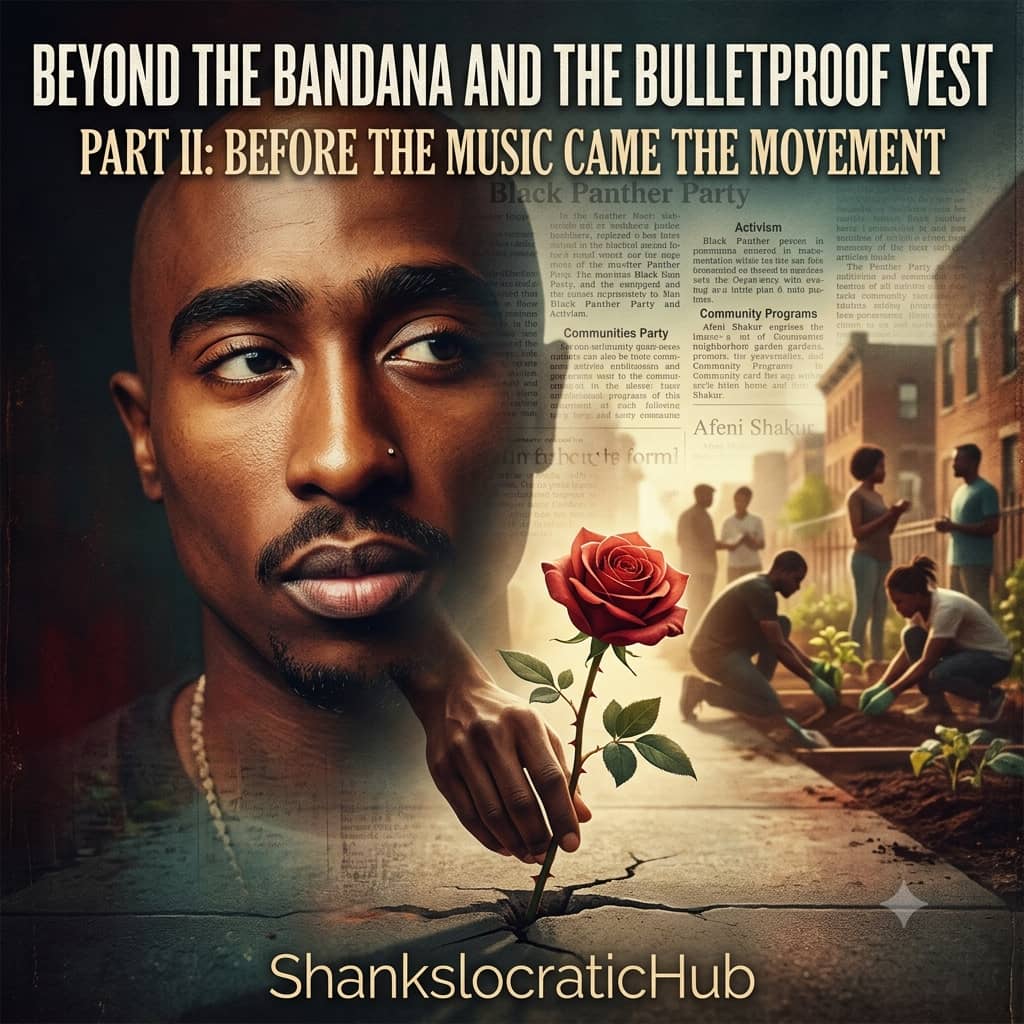
Beyond the Bandana and the Bulletproof Vest
Part II: Before the Music Came the Movement
In the previous reflection, we left Tupac standing at the edge of a question: why did he consistently ask listeners to look beyond the symptoms and examine the conditions that produced them? The answer begins long before platinum records and global fame. It begins with the political inheritance that shaped the boy before he became the artist. Tupac Shakur did not discover social consciousness after success. He was born into it. His mother, Afeni Shakur, was a member of the Black Panther Party. He grew up surrounded by stories of surveillance, activism, imprisonment and resilience. The language of systemic oppression was never an abstract theory discussed in classrooms. It formed part of the atmosphere in which he was raised. Before he learned to write songs, he had already learned that race, power and justice were inseparable conversations. He also came of age during one of the most turbulent periods in modern American urban history. The aftershocks of deindustrialization and the crack epidemic left entire neighbourhoods struggling beneath collapsing opportunities while public discourse increasingly portrayed those same communities as responsible for their own suffering. Families fractured. Schools struggled. Children inherited burdens they never chose. Generational trauma rarely announces itself dramatically. It teaches survival before stability, suspicion before trust and vigilance before peace. That is why reducing Tupac's music to anger misses its emotional architecture. Beneath the rage lived grief. Beneath the defiance lived disappointment. Beneath the bravado lived exhaustion. One hears this most clearly in Dear Mama. The song is far more than a tribute to his mother. It rescues her from simplistic judgment. Tupac acknowledged Afeni's addiction without allowing addiction to erase her dignity. He remembered sacrifice alongside suffering and resilience alongside imperfection. In doing so, he challenged a society that often demands flawless heroes or irredeemable failures, insisting instead that brokenness and worth can exist within the same person. The same moral imagination surfaces in Keep Ya Head Up. What many remember as an uplifting anthem is equally a critique of intersecting inequalities. Race, poverty and gender converge within its verses, exposing how women in marginalized communities often carry burdens produced by systems they did not create. Compassion, for Tupac, was never sentimental. It was political. This explains another enduring misconception about his work. He did not glorify the ghetto. He humanized it. To glorify suffering is to make misery attractive. To humanize suffering is to restore names, faces and dignity to people too often discussed only through statistics. Statistics inform. Stories persuade. Perhaps that is why Tupac's music continues to resonate far beyond the United States. A listener in Ibadan, Kingston or São Paulo may never have walked the streets he described, yet the emotional grammar feels familiar. Communities neglected by institutions often recognize one another even when separated by oceans. The details change. The pattern remains. His gift was not simply that he described hardship. It was that he connected private pain to public structures without losing sight of individual humanity. He refused to let poverty erase dignity or allow social analysis to eclipse compassion. That balance became one of his greatest strengths. It also laid the foundation for one of the greatest misunderstandings of his life. The more deeply his convictions were rooted in justice, the more aggressively the public image of "2Pac the thug" began to eclipse the thoughtful observer behind the microphone. The movement shaped the man. The world, however, would come to know the myth.
And somewhere between those two stories lies the Tupac we still struggle to understand.




7 comments
Log in to join the conversationTupaccc
The unseen message
Tupac
Tupac Shakur
The part II found me
I heard his K1ller was recently found?
As of August 31, 2026, Duane “Keffe D” Davis, the 63-year-old former gang leader, has been found guilty of the murder of rapper Tupac Shakur.
Justice, at last after almost 30 years.