
The Last Currency
Money is not supposed to vanish in our lifetime. Yet in late July 2026, Elon Musk sat down with Zanny Minton Beddoes, editor-in-chief of The Economist, and made the kind of prediction that splits a room cleanly in two:
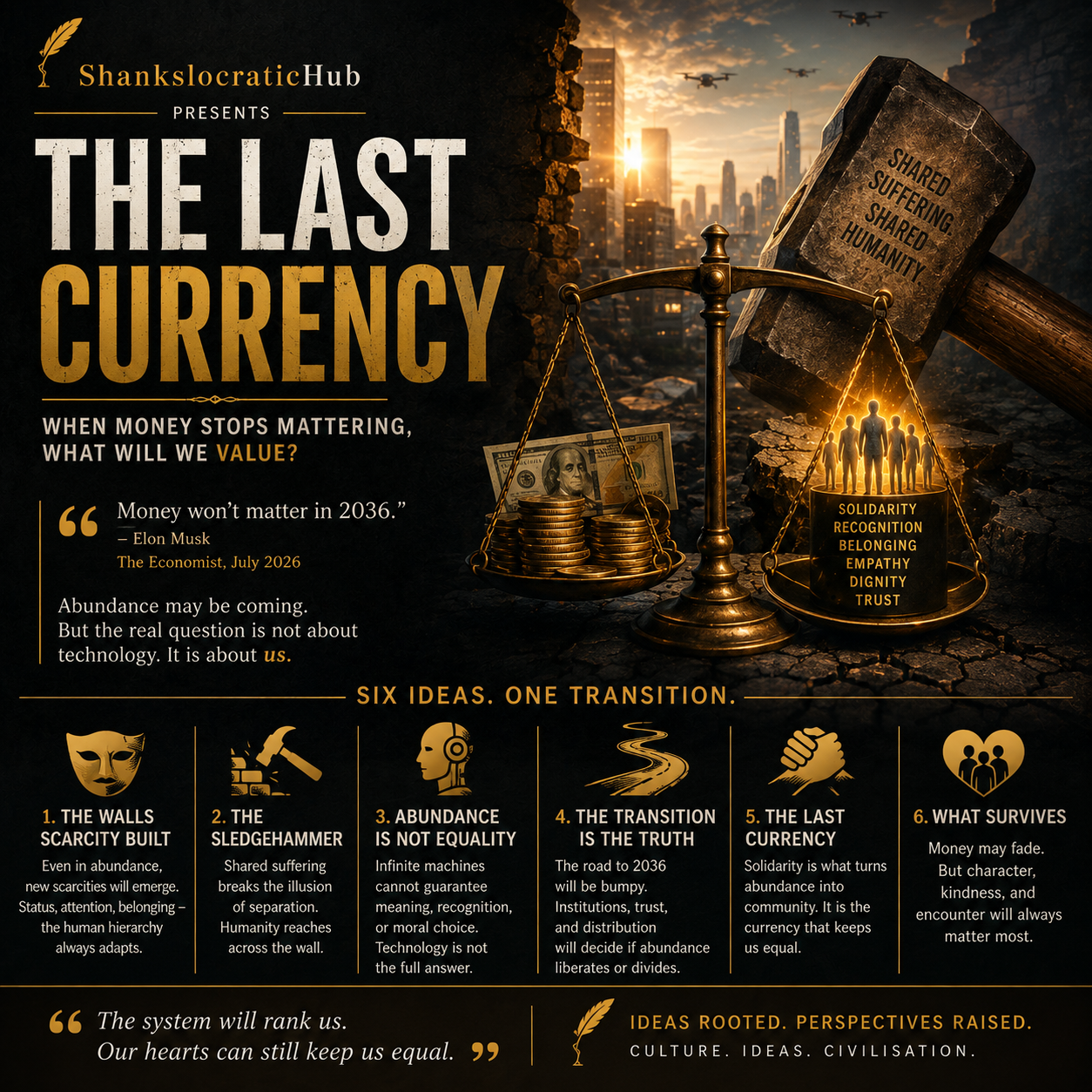
“Money won’t matter in 2036.”
That is either the first sentence of a utopian future or the opening line of a very expensive delusion. Musk’s reasoning was straightforward. If robots and AI can produce more food, housing, transport, and entertainment than human beings could ever reasonably consume, then the old logic of scarcity starts to lose its grip.
The walls scarcity built
Sociology has a way of irritating technologists because it refuses to confuse invention with transformation. Class is not only an economic arrangement. It is a social architecture. Money is the visible surface, but beneath it sit status, access, belonging, and the stories people are allowed to tell about themselves.
So even if Musk’s abundance arrives, even if AI and robotics drive the cost of basics toward the floor, class will not simply disappear. It will mutate. New scarcities will emerge: a place at the right school, access to the right room, the attention of the right person, the feeling of being chosen, the quiet assurance of being needed.
Money has never been only a medium of exchange. It has also been a language of recognition. It told people their labor counted, their presence mattered, their effort could be translated into dignity. Remove the language, and the longing does not end. It just becomes harder to name.
The sledgehammer
Class walls are real. But so is the force that sometimes breaks them: shared suffering.
The transition is the truth
The most important part of any prophecy is not the date. It is the passage between here and there.
Musk has already admitted that the road to 2036 will be bumpy, and that may be the most grounded part of the entire claim. History is not kind to smooth transitions. Previous waves of automation brought disruption, displacement, and institutions scrambling to respond after the fact.
So the real question is not whether AI can create abundance. It is whether societies can distribute that abundance without creating new elites, new bottlenecks, and new forms of exclusion.
The last currency
So what becomes the real currency of 2036?
If Musk is right, it will not be dollars, crypto, or treasury checks. It will be solidarity.
Solidarity is what turns abundance into community. It is what keeps a post-scarcity world from becoming a post-empathy one. It is the sledgehammer that breaks the walls technology cannot touch: contempt, indifference, and the quiet belief that some lives are worth less than others.
The system will always try to rank us. New hierarchies will rise to replace old ones. But the antidote to ranking is not abundance alone. It is encounter - the messy, uncomfortable, beautiful work of seeing another person and refusing to look away.
That is why Musk’s prediction matters, even if the date proves wrong.
What survives
In the end, the most important interview is not the one Musk gave to The Economist. It is the one we answer every day in the small transactions of attention, kindness, and courage that never make headlines.
Money may or may not matter in 2036. That is a bet on technology. Whether we matter to each other is a bet on character. And character, unlike code, does not update overnight.
The walls of class are old, clever, and durable. They will find new materials even in a world of abundance. But so will the sledgehammer. It has always been in the hands of ordinary people who decide, in crisis and calm alike, that the person on the other side of the wall is not a rival but a kin.
Musk imagines a future where goods are free. The deeper hope is a future where goodness is free - freely given, freely received, freely multiplied. That is the abundance worth building. That is the 2036 worth arriving at.
And that journey does not begin in a Gigafactory. It begins in the quiet, radical decision to treat another human being as if money had already stopped mattering.
That is either the first sentence of a utopian future or the opening line of a very expensive delusion. Musk’s reasoning was straightforward. If robots and AI can produce more food, housing, transport, and entertainment than human beings could ever reasonably consume, then the old logic of scarcity starts to lose its grip.
In that world, he suggested, deflation matters more than inflation, and the machinery of money begins to look less like necessity and more like habit.
Beddoes did what any serious editor should do: she pressed back. What happens to investors? What happens to workers? What happens to societies already stretched thin by polarization, anxiety, and distrust?
Musk’s answer was not comfort but ambivalence. He described AI as both “exhilarating and terrifying,” which may be the most honest thing any billionaire has said about the future in some time.
And that is where the deeper argument begins.
The walls scarcity built
Sociology has a way of irritating technologists because it refuses to confuse invention with transformation. Class is not only an economic arrangement. It is a social architecture. Money is the visible surface, but beneath it sit status, access, belonging, and the stories people are allowed to tell about themselves.
So even if Musk’s abundance arrives, even if AI and robotics drive the cost of basics toward the floor, class will not simply disappear. It will mutate. New scarcities will emerge: a place at the right school, access to the right room, the attention of the right person, the feeling of being chosen, the quiet assurance of being needed.
Money has never been only a medium of exchange. It has also been a language of recognition. It told people their labor counted, their presence mattered, their effort could be translated into dignity. Remove the language, and the longing does not end. It just becomes harder to name.
The sledgehammer
Class walls are real. But so is the force that sometimes breaks them: shared suffering.
Floods do not check your tax bracket. Pandemics do not pause at the gate of the wealthy. When the lights go out, darkness arrives with no regard for status. In those moments, the illusion of permanent separation weakens, because human beings are forced back into one another’s reach.
That is the paradox Musk’s prediction brushes against without fully entering. Abundance is a technological achievement. Equality is a relational one.
You can have infinite machines and still have infinite loneliness. You can have free housing and still have homeless souls. You can erase material shortage and still leave people hungry for recognition, meaning, and the simple relief of mattering to someone else.
Musk has pointed to Iain M. Banks’s Culture novels as a model for a positive AI future; a post-scarcity civilization in which advanced machine intelligences handle production and money becomes almost obsolete.
But even that imagined world is not really about gadgets. It is about what remains when survival is no longer the central drama: moral choice, identity, freedom, and the question of what a human being becomes when necessity no longer drives the story.
The transition is the truth
The most important part of any prophecy is not the date. It is the passage between here and there.
Musk has already admitted that the road to 2036 will be bumpy, and that may be the most grounded part of the entire claim. History is not kind to smooth transitions. Previous waves of automation brought disruption, displacement, and institutions scrambling to respond after the fact.
So the real question is not whether AI can create abundance. It is whether societies can distribute that abundance without creating new elites, new bottlenecks, and new forms of exclusion.
Do we trust the institutions that would manage it? Do we trust the corporations that own the machines? Do we trust one another not to hoard the next scarce thing, whether it is attention, status, or belonging?
Because the most persistent scarcity has never been purely material. It has been mutual.
Money has always been more than currency. It was a proxy for recognition: I value your work, I see your labor, I acknowledge your place in the world. If that system disappears without something more human taking its place, people are not liberated. They are left exposed.
The last currency
So what becomes the real currency of 2036?
If Musk is right, it will not be dollars, crypto, or treasury checks. It will be solidarity.
Solidarity is what turns abundance into community. It is what keeps a post-scarcity world from becoming a post-empathy one. It is the sledgehammer that breaks the walls technology cannot touch: contempt, indifference, and the quiet belief that some lives are worth less than others.
The system will always try to rank us. New hierarchies will rise to replace old ones. But the antidote to ranking is not abundance alone. It is encounter - the messy, uncomfortable, beautiful work of seeing another person and refusing to look away.
That is why Musk’s prediction matters, even if the date proves wrong.
It forces a harder question than economics alone can answer:
If money stops mattering, what will we have practiced in its place?
Will we have learned to distribute dignity as carefully as we hope to distribute goods? Will we have built institutions that reflect shared humanity instead of optimized extraction? Will we have become the kind of people who can recognize worth without first checking for a price tag?
What survives
In the end, the most important interview is not the one Musk gave to The Economist. It is the one we answer every day in the small transactions of attention, kindness, and courage that never make headlines.
Money may or may not matter in 2036. That is a bet on technology. Whether we matter to each other is a bet on character. And character, unlike code, does not update overnight.
The walls of class are old, clever, and durable. They will find new materials even in a world of abundance. But so will the sledgehammer. It has always been in the hands of ordinary people who decide, in crisis and calm alike, that the person on the other side of the wall is not a rival but a kin.
Musk imagines a future where goods are free. The deeper hope is a future where goodness is free - freely given, freely received, freely multiplied. That is the abundance worth building. That is the 2036 worth arriving at.
And that journey does not begin in a Gigafactory. It begins in the quiet, radical decision to treat another human being as if money had already stopped mattering.
The system may rank us. But our hearts can still keep us equal.
(This essay was inspired by Elon Musk’s July 2026 interview with Zanny Minton Beddoes for The Economist’s The Insider, and by the enduring sociological truth that abundance without empathy is just scarcity wearing a mask.)




23 comments
Log in to join the conversationLol, impossible
"Impossible" has become one of the least reliable words of the 21st century. 🙂 The piece isn't arguing that banknotes would vanish overnight. It's asking whether money could stop being the ultimate measure of human worth. History has repeatedly shown that currencies change. The deeper question is: what becomes society's next currency?
I get it now. Didn't read the whole message earlier. They are too rich and don't see any worth in cash anymore
The final line is powerful. Technology might change how we live, but choosing to treat people with dignity will always be a human decision.
Whether Musk is right about 2036 or not, AI is definitely forcing us to rethink what work, value and purpose actually mean.
The idea of solidarity as the “last currency” is beautiful, but also probably the hardest one to create.
Money disappearing doesn’t necessarily mean inequality disappears. Humans can build hierarchies out of almost anything.
I like the distinction between abundance being technological and equality being relational. Very important point.
This makes you wonder: if AI does most of the work, what exactly will humans define themselves by?
Maybe the next status symbol won’t be money. It’ll be access, influence, time, attention and human connection.
Technology can reduce scarcity, but it cannot automatically distribute resources fairly. That’s where things could get messy.
The question “what will we have practiced in its place?” is probably the most important part of this whole piece.
I don’t think money will completely disappear. Humans have a funny way of creating value around whatever becomes scarce.
You can have infinite machines and still have infinite loneliness.” That sentence deserves its own conversation.
Musk is thinking about abundance. This essay is asking whether humanity is ready for it. Big difference.
Imagine a world where food and housing are basically free, but people are still fighting for attention and recognition. That’s a serious possibility.
The part about new forms of scarcity is very real. Even if everything is cheap, access and connections may become the new luxury.
This is why technology alone cannot create an equal society. People and institutions still matter.
Honestly, the transition to 2036 might be more important than the prediction itself
Abundance without empathy is just scarcity wearing a mask.” That line really hit.
AI can solve scarcity, but I don’t think it can solve the human need to feel valued.
This is deeper than just “money won’t matter.” The real question is what replaces it.