
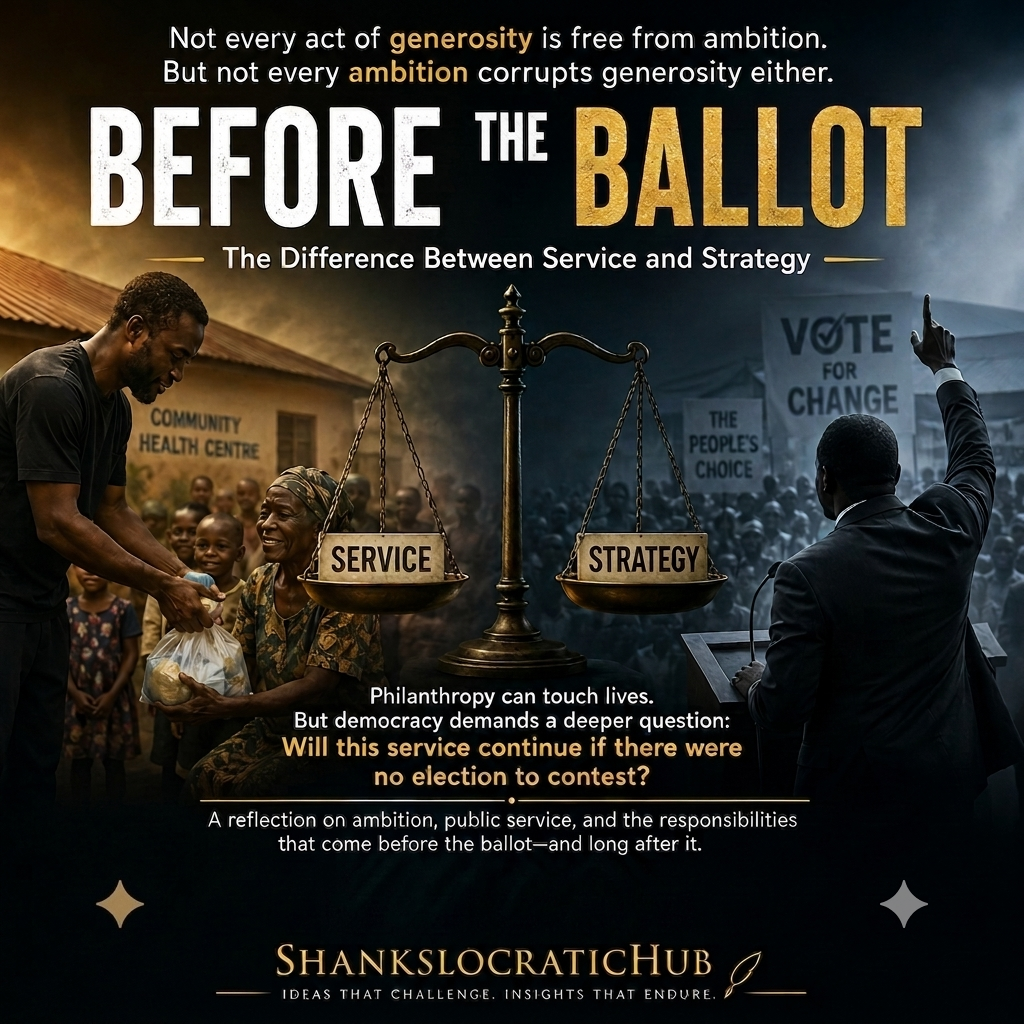
Before the Ballot: The Difference Between Service and Strategy
There is a question Nigerians do not ask often enough.
When someone spends years helping people, are they serving society or simply introducing themselves to voters?
It is an uncomfortable question because genuine service exists. So does calculated generosity. The challenge is that, from a distance, both can look remarkably alike.
Recently, during a podcast discussion, Idris Animasaun (alias Mogaji Molete) posed a question that deserves to outlive the politics surrounding it:
'Are we really doing philanthropy to actually touch the people or we've been doing philanthropy to wet the ground because we want to contest?... What's the quality of life of the people around you?'
Whether one agrees with that is secondary. The principle behind the question is what matters.
Philanthropy has always occupied a curious place in politics. It can be an expression of compassion. It can also become an investment.
A bag of rice may relieve hunger today. A scholarship may change a life. A hospital bill paid for a struggling family is no small gesture. Yet democracy demands that we ask a deeper question beyond gratitude:
Would this service continue if there were no election to contest?
Intentions are difficult to measure, but patterns are not.
Does the service endure when cameras disappear?
Does it survive electoral defeat?
Does it extend beyond areas with political value?
Is it building institutions or merely building personal loyalty?
These questions matter because democracy is weakened when citizens become clients rather than stakeholders.
This is not about any single individual. It is a mirror held up to every activist, philanthropist, media personality, religious leader, businessman, and community influencer who eventually seeks public office.
Politics is not disqualified by ambition. In fact, ambition is necessary. Many of history's finest leaders desired office because they believed they could improve society.
The problem begins when public service becomes less about solving problems and more about creating political capital.
That is where activism quietly transforms into branding.
Charity becomes advertising.
Empathy becomes strategy.
Influence becomes currency.
Ironically, this was the warning behind Between Activism and Power. The greatest danger was never that activists would enter politics. Democracies need principled people to do exactly that.
The danger is entering politics already changed by the pursuit of power.
Because power has a peculiar habit of rewriting our motives without asking our permission.
The activist who once demanded accountability may begin demanding loyalty.
The journalist who once questioned politicians may become uncomfortable with questions.
The philanthropist who once served people may gradually begin serving an ambition.
None of these changes happen overnight. They happen one compromise at a time.
That is why every aspiring leader should periodically ask a simple but uncomfortable question:
If politics were taken away from me today, would I still be doing this work tomorrow?
The answer reveals whether service is a calling or merely a campaign waiting for its official launch.
Ultimately, citizens also bear responsibility.
We should appreciate generosity without surrendering our judgment.
We should applaud service without abandoning scrutiny.
We should support leaders not because they gave the most, but because they can govern the best.
A grateful people must never become an unquestioning people. For the measure of leadership is not how much was shared before the election, but how much justice, opportunity, and dignity are secured after it.
Public service should prepare someone for leadership. It should never become a substitute for proving they deserve it.



35 comments
Log in to join the conversationNigeria will change the day voters start rewarding performance over publicity.
Whether you're an activist, businessman, or pastor, the same question applies: would you still serve if there was nothing to gain?
A grateful people must never become an unquestioning people." That line deserves to be framed.
We should judge politicians by their policies and results, not by the number of food packs they share.
The best leaders are those whose work speaks even when elections are years away.
A lot of people will feel attacked by this post, but it raises valid concerns.
This is a reminder that gratitude and critical thinking can exist together.
We need leaders who build schools, hospitals, and jobs not dependency.
Politicians know Nigerians are struggling, so it's easy to win hearts with giveaways.
Sometimes philanthropy fills the gap because government has failed. That's another angle to consider.
This is why civic education is so important in Nigeria.😂😂😂
😂💯 Agree with you
We shouldn't vote because someone paid hospital bills. We should vote for competence.
Every voter should read this before the next election.
Leadership should solve problems permanently, not temporarily.
The camera test is important. Would they still do it if nobody was recording?
We celebrate generosity too quickly and forget to demand accountability.
If your good deeds stop after you lose an election, then maybe they weren't really about service.
It's possible to genuinely care for people and still want to run for office. The issue is consistency.
The line about "activism becoming branding" really hit hard.
This article asks questions many people are afraid to ask.