
I Did Not Kill Him, He Died On Top Of Me Says Mistress Of Late Abacha.
I did not kill him, he died on top of me,” that was the confession of the lady who was with former military Head of State, Gen. Sani Abacha, when he suddenly passed on.
A retired security operative, Dennis Amachree, said the lady, a pharmacist, made the confession when he interrogated her over Abacha’s mysterious death.
Amachree, who gave his own version of Abacha’s last moments, clarified that the former military ruler passed on around 4.05 am on June 8, 1998, at the Aso Villa, Abuja, in the presence of the lady during an intimate affair.
Gen. Abacha was Nigeria’s military ruler between November 1993 and July 1998 when he suddenly passed on.
He was the seventh military leader. He died at 54.
Given the manner of his death, there were speculations about what killed him and the circumstances of his death.
“The lady pharmacist’s account, on whom Abacha apparently had a coitus-induced cardiac arrest, remains the true position, and puts an end to the conspiracy theories and half-truths that have gone viral,” he stressed.
Amachree, who was the Assistant Director of Operations and Intelligence at the Lagos State SSS Command, at the time of Abacha’s death, emphasised that “any other narrative is an act of deceit and a disservice to our countrymen and women.”
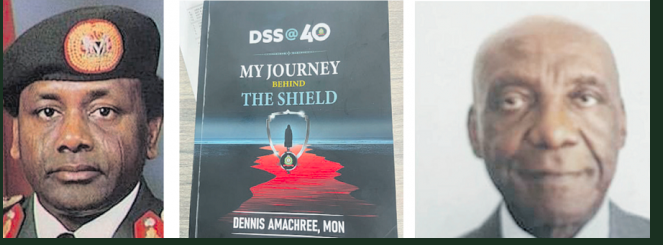
He made the revelation in his 348-paged book, just released, titled: ‘DSS @40: My journey behind the shield. The retired Assistant Director of Department of State Services (DSS) said after witnessing Abacha’s death, the lady-pharmacist immediately joined the next flight to Lagos.
Amachree stated in Chapter 17 of the book titled: ‘The months of death: A turning point in Nigerian history,’ that he interrogated the lady in Ogudu, Lagos, following a call from the Director of Operations at the DSS National Headquarters.
He said: “My team located and brought her to my office. I interrogated her myself. The first thing she said to me was : ‘I did not kill him, he died on top of me.’ After her detailed account, I called the Director in Abuja, and she was immediately flown back.”.
Abacha died barely a month before the death of Chief Moshood Abiola, winner of the historic June 12, 1993 presidential election, on July 7, 1998, who was in Abacha’s custody.
Following the protest and furore that followed Military President Gen. Ibrahim Babangida’s annulment of Abiola’s victory, he stepped aside and installed an unelected civilian Chief Ernest Shonekan as interim head of state with General Abacha as defence minister.
Nigerians roundly rejected the arrangement and Gen. Abacha took that advantage to force out Chief Shonekan, barely three months after. Gen. Abacha then became the head of state and a full blown dictator.
Amachree noted that “Abacha’s five and half year rule was a period of extreme authoritarianism and brutal repression, adding that his regime was widely condemned for widespread human rights abuses, including arbitrary arrests, torture, and extra-,judicial killings.
The author said “the number of political detainees during his tenure reportedly exceeded the total from the entire British colonial period.
Few days before he died, the dictator received emmisaries from the Palestine Liberation Organisation (PLO) leader, Yasser Arafat. He also received Pope John Paul 11, who had visited Nigeria to plea for the release of detainees.
Indeed, the Pope was the last visitor that Gen. Abacha received.
Amachree acknowledged the enduring speculation and misery surrounding Abacha’s death, consequent upon the conflicting narratives. Many accounts were published, but few were based on verifiable facts. “These range from fictional stories of a poisoned apple from disaffected soldiers, to more sensational claims involving foreign intelligence agencies.
Setting the record straight
The author disputed the claims of six people, whose narratives never resolved the riddle.
The first is David Orr of The Irish Times. Of his speculation, the author stated: “A journalist’s account cited an unnamed diplomat claiming Abacha was poisoned by a small group of disaffected military officers. While dramatic, this narrative was contradicted by a Nigerian newspaper report citing autopsy results that ruled out poisoning.”
On Susan Rice’s testimony, Amachree said:” The former US National Security Advisor’s account, while condescending, echoed the widespread rumour that Abacha died in the company of prostitutes, possibly due to Viagra use. This version, while popular, lacks concrete evidence and is dismissed by those close to the late Head of State.”
He also rejected Major Hamzat Al-Mustapha’s account, saying: “As Abacha’s Chief Security Officer, his account is often considered a key source, though it contains notable inconsistencies. He claimed Abacha’s health collapsed after a handshake with a security guard of a visiting dignitary. This version, while exonerating the “poisoned apple” theory, differs significantly from other timelines and accounts.”
Also dismissing the late Gen. Jeremiah Useni’s suggestions, Amachree said: “A close friend of Abacha, Useni’s narrative provides a different timeline of events, contradicting Al-Mustapha’s account regarding the final hours. He supported the official story of death by natural causes, citing autopsy results from multiple countries.”
The opinion of a medical officer, Brig-General Oviemo Ovadje, was also rejected. “His account offers a different perspective, suggesting Abacha’s death was a result of long- term health issues exacerbated by poor medical management, including the use of steroids.”
The author dismissed Femi Fani-Kayode’s speculation. He said the former Aviation Minister’s social media posts present a conspiracy theory alleging a CIA-orchestrated plot involving a poisoned handshake, with the complicity of other former Nigerian leaders.
“While lacking evidence, this narrative highlights the deep-seated public distrust and willingness to believe external forces are pulling the strings.”
Amachree said the most sensational of these stories of imported Indian prostitutes, a poisoned apple, and CIA involvement have been widely circulated, muddying the historical record.
He said he therefore, decided to clarify the authentic and accurate fact. “As a security professional who was in the thick of it, I feel compelled to set the record straight and provide the true narrative for posterity, the author added.
The most important account was that of Al-Mustapha, being the closest officer to him. He has consistently tried to defend his late boss’ image, attributing his death to a mysterious handshake from a foreign security operative.
He claimed that Abacha’s health declined after shaking hands with a member of PLO leader Yasser Arafat’s entourage on June 8.
According to his account, Abacha was stabilised by a doctor at 6pm and was receiving visitors until Gen. Useni left at 3.35pm the following day. Al- Mustapha’s explanation ends there, claiming he went home to rest and was only alerted to Abacha’s instability at 5 am.
Amachree insisted that Al-Mustapha’s account has a critical gap, stressing that “ he missed the one and half window after Gen. Useni’s departure that provides the key to the mystery.”


14 comments
Log in to join the conversationNa today una remember? But na wa o imagine married man dying on side chicks body while committing adultry. Him he’ll fire go gbim
Too late a story
Torr
Is there any need for this
Do you think this account finally settles the mystery, or are there still too many unanswered questions?
Whether people believe this version or not, it's definitely going to spark discussions.
Reading different eyewitness accounts reminds us how difficult it can be to establish historical truth.
I think people will still debate this for a long time.
If these claims are true, they certainly change the conversation.
This is one of those moments in Nigerian history that still raises many questions.
There have been so many versions of this story over the years.
It'll be interesting to see what evidence is presented in the book.
History always seems to reveal new details years later.
That's a shocking account if it's accurate.