
The Power That Was Never Meant to Last: The Gadaa System and Africa's Forgotten Philosophy of Temporary Authority
"Power belongs to society before it belongs to any individual."
History is shaped not only by what happened but also by the questions historians ask. Much of Africa's past was interpreted through European political categories, where kingdoms, hereditary monarchies, and permanent rulers were treated as the benchmarks of civilisation. When early observers encountered societies that organised power differently, they often mistook difference for deficiency.
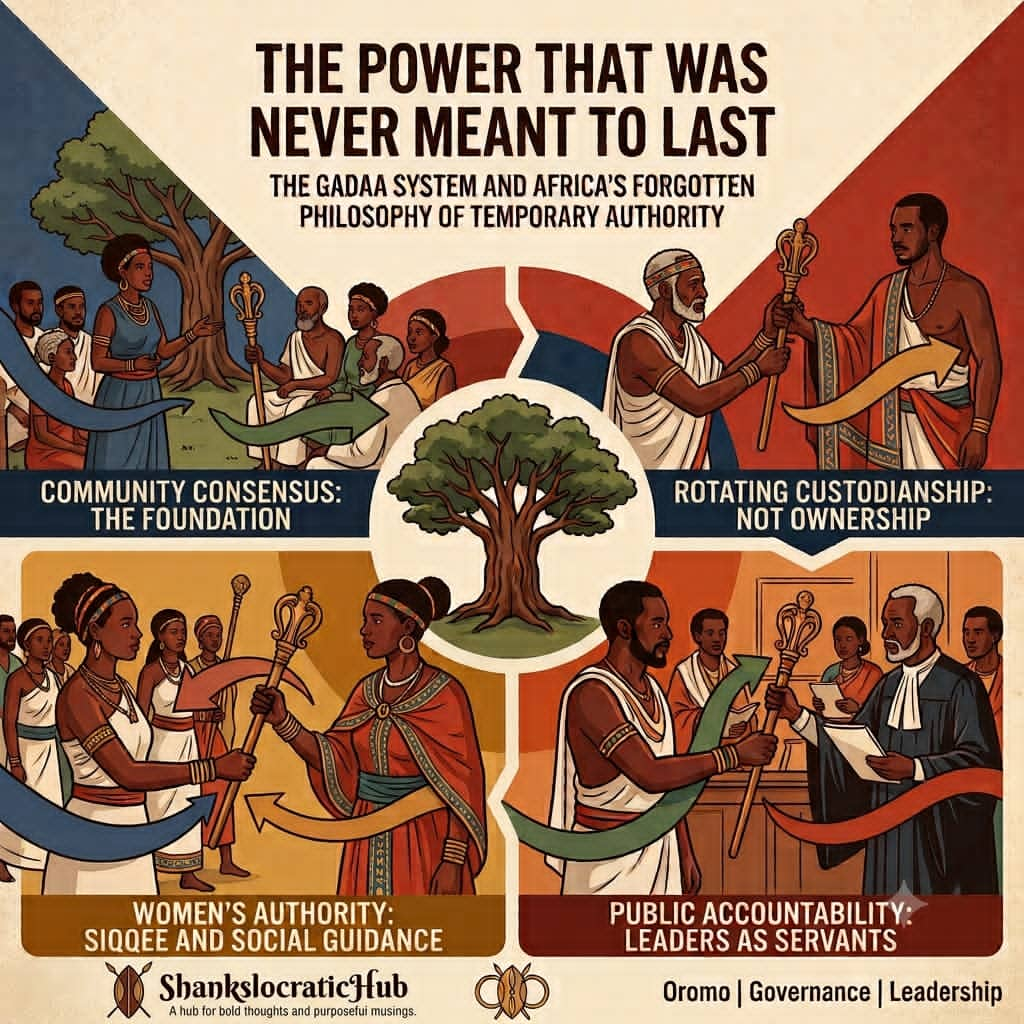
Among the Oromo of present-day Ethiopia and Kenya, the Gadaa System offered a radically different vision. Far more than a traditional custom, it was, and remains a sophisticated framework of governance, law, and civic organisation built on one profound idea: power belongs to society before it belongs to any individual. The leader does not own authority; he merely holds it in trust for a season. Recognising its historical significance and continued vitality, UNESCO inscribed Gadaa on its Representative List of the Intangible Cultural Heritage of Humanity in 2016.
A Constitution Built Around Time
Gadaa regulated leadership, legislation, justice, military organisation, and civic responsibility through clearly defined eight-year governing cycles. Leadership advanced through established age grades rather than hereditary privilege or personal ambition. The Abbaa Gadaa served not as an absolute monarch but as a steward accountable to the community.
Succession was never an unexpected crisis.
It was the system working exactly as intended.
Power did not expire because leaders failed.
It expired because institutions succeeded.
The Wisdom of Temporary Authority
The Oromo were not alone in recognising this principle. Across Africa, societies developed their own philosophies about the impermanence of authority. Among the Yoruba, these ideas survived in proverbs and ritual memory.
One proverb reminds us:
"Eni Egúngún n lé, kó máà rójú; bó ti ń rẹ ará ayé ló ń rẹ ará òrun."
Those pursued by Egúngún should persevere, because even those from heaven grow weary.
Even power becomes tired.
Another declares:
"Ilé Ọba tó jó, ẹwà ló bù sí."
When the king's palace burns, it only becomes more beautiful.
The institution survives the individual.
A third captures the restless nature of ambition:
"Orí Adétù ń pété aran; orí eláran ń pété àti jẹ́ ọba."
Adetu longs for expensive cloth; the cloth merchant longs to become king.
Human ambition never disappears.
It merely changes its object.
The Oromo encoded this wisdom in institutions. The Yoruba preserved it in proverbs. One built constitutional cycles; the other cultivated cultural memory. Both arrived at the same political conclusion:
Power is safest when it remembers that it is only passing through.
Why It Still Matters
Modern politics often assumes that power must be preserved at all costs. From that illusion emerge desperate alliances, political betrayals, constitutional manipulation, and succession crises.
Gadaa offers another possibility. If power is understood from the beginning as temporary, leaders prepare successors instead of eliminating rivals. Institutions become more valuable than personalities. Political transition becomes a normal rhythm rather than a threat.
History moves in seasons.
So does power.
Every generation eventually becomes history.
The enduring importance of Gadaa is not that it provides a blueprint for every modern state. It preserves a political insight that many societies still struggle to embrace:
Power should have limits because human beings do.
No individual is permanent.
No alliance is eternal.
No office should become an extension of personal identity.
Perhaps the greatest misunderstanding was never that early observers failed to find kings among the Oromo.
Perhaps it was assuming that a society required one in the first place.
Civilisations are measured not only by how they choose their leaders but by whether they can survive replacing them. The Oromo understood this centuries ago.
Power reaches its highest form not when it refuses to leave, but when it knows when its time is over.




25 comments
Log in to join the conversationWhich other African governance systems do you think deserve more global recognition?
This is one of the most insightful pieces I've read in a while.
Power is borrowed, not owned. That's a lesson worth remembering.
Real leadership is preparing others to lead after you.
This changed the way I think about political power.
Leadership without accountability eventually becomes dangerous.
Africa has so much history the world still needs to appreciate.
Every politician should read this at least once.
This is why preserving indigenous knowledge matters.
The comparison between Gadaa and Yoruba philosophy was beautifully explained.
Great reminder that no leader is bigger than the system.
Temporary authority creates stronger institutions in the long run.
History has often overlooked African innovations. Posts like this help change that.
This deserves to be taught in schools across Africa.
The quote "Power belongs to society before it belongs to any individual" really stands out.
Leadership is service, not ownership. Powerful message.
This proves Africa has always had sophisticated political systems.
Imagine if more countries embraced peaceful and predictable leadership transitions.
I learned something new today. Thanks for sharing.
Institutions should always outlive individuals. That's the real lesson here.