
AI: The Good, the Bad & the Ugly
From ELIZA to Humanoid Robots—How Artificial Intelligence Changed Everything
Artificial Intelligence didn't appear overnight. It evolved through decades of breakthroughs—from proving mathematical theorems to learning patterns, understanding language, generating images and holding conversations. Each breakthrough built upon the last. What many Nigerians only began embracing around 2023 had, in reality, been quietly evolving for nearly seventy years.
A Brief Journey Through AI History
The story began in 1956, when Allen Newell and Herbert Simon built the Logic Theorem Prover, demonstrating that machines could perform logical reasoning rather than mere calculations.
A year later, Frank Rosenblatt introduced the Perceptron, showing that machines could learn from examples. Artificial neural networks had arrived.
The early 1960s brought systems like Johnny, SAD-SAM and STUDENT, each taking small but important steps towards enabling computers to understand and process human language.
Then came ELIZA in 1966. Created by Joseph Weizenbaum, ELIZA simulated conversations using simple pattern matching and is widely regarded as the world's first chatbot. Although primitive by today's standards, it revealed something remarkable: people were willing to converse with machines.
For years, AI progressed quietly until a major breakthrough arrived in 1986 with the popularisation of backpropagation, an algorithm that enabled neural networks to learn far more effectively from their mistakes. Modern AI owes much of its success to this breakthrough.
In 1997, IBM's Deep Blue defeated reigning world chess champion Garry Kasparov, proving that machines could surpass even the world's greatest human experts in specialised tasks.
The next turning point came in 2011 with Apple's Siri, bringing AI into millions of smartphones.
Then, in 2016, Google's AlphaGo defeated legendary Go player Lee Sedol, demonstrating that AI could master problems once thought too intuitive for computers.
Between 2018 and 2019, OpenAI introduced the GPT series, laying the foundation for today's large language models.
Finally, 2022 changed everything.
ChatGPT transformed public perception of Artificial Intelligence almost overnight. Soon came Gemini, Claude, Copilot, Perplexity, Grok, Kimi AI and many others. AI was no longer confined to research laboratories—it became an everyday tool for students, teachers, doctors, lawyers, programmers, researchers and businesses across the globe.
Today, AI generates text, images, music, videos and computer code. It is also beginning to take physical form through humanoid robots capable of walking, conversing and performing real-world tasks.
THE GOOD
Artificial Intelligence has become one of humanity's most powerful productivity tools.
Doctors use AI to detect diseases earlier, analyse medical scans and accelerate drug discovery. Students now have tutors available around the clock, while teachers prepare lesson plans, assessments and learning materials in a fraction of the time. Farmers monitor crops, predict weather patterns and identify plant diseases before they spread. Businesses automate repetitive tasks, freeing people to focus on more creative and strategic work. Scientists increasingly use AI to analyse enormous datasets and speed up discoveries that once took months—or even years.
AI is also becoming an important ally in protecting the planet. It helps predict extreme weather, monitor deforestation, optimise renewable energy systems, reduce emissions, improve disaster preparedness and support climate research. In many ways, AI is helping humanity respond more effectively to the growing challenge of climate change.
THE BAD
Every technological revolution creates both opportunities and disruptions.
AI is already reshaping employment. Routine jobs such as customer support, data entry, transcription, basic programming and certain forms of content creation are increasingly being automated.
The emerging reality is simple:
AI may not replace everyone—but people who effectively use AI will often replace those who don't.
Another growing concern is misinformation. Deepfakes now produce convincing fake videos, cloned voices and fabricated images, making it increasingly difficult to distinguish truth from deception. Schools also face a dilemma as students rely heavily on AI for assignments, raising questions about originality, critical thinking and genuine learning.
Privacy presents another challenge, since modern AI systems depend on enormous amounts of personal and behavioural data.
THE UGLY
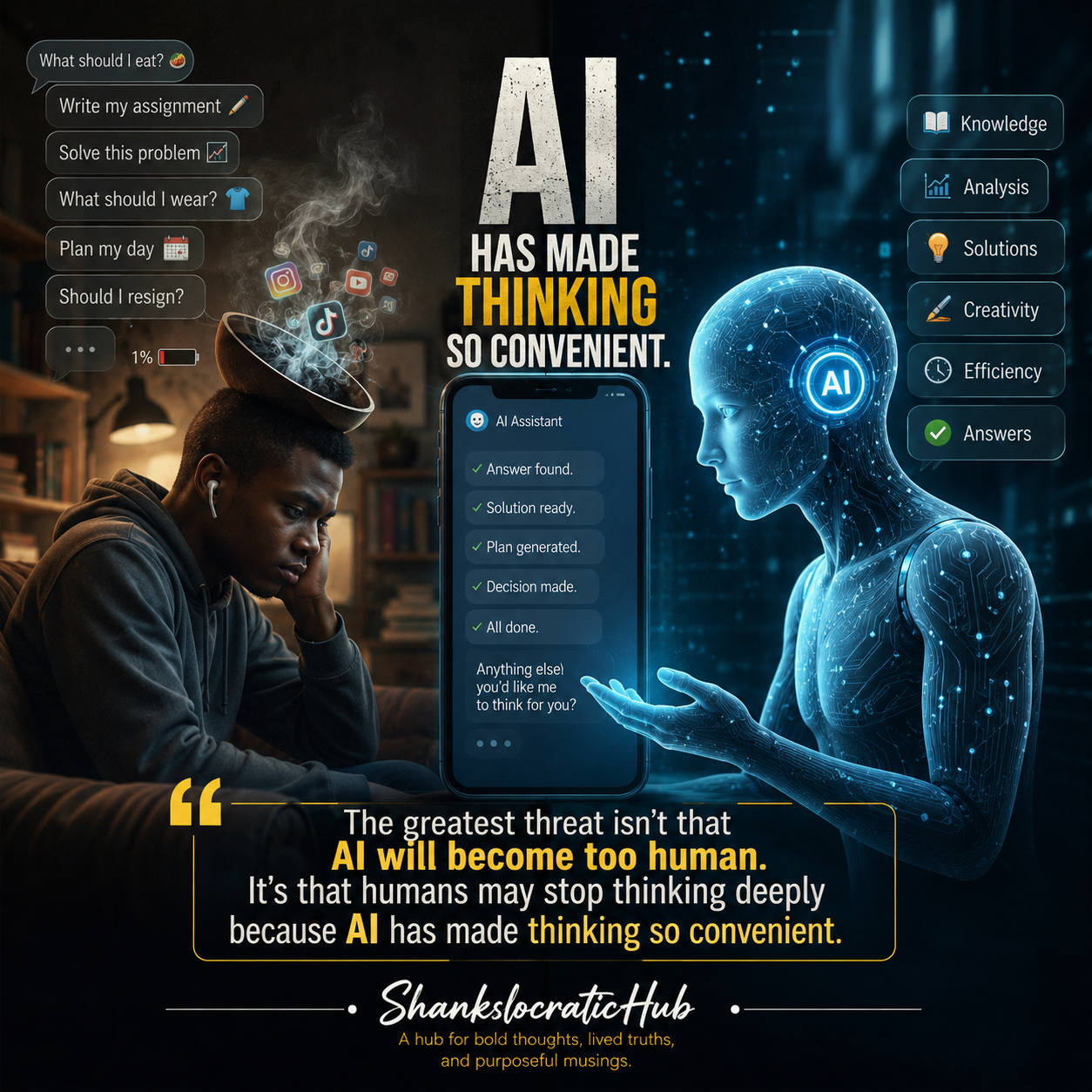
Perhaps the greatest concern is not that AI is becoming intelligent—but that humans may become excessively dependent on it.
There is a growing temptation to outsource not only routine tasks but judgment itself. People increasingly ask AI what to study, whom to date, what investments to make, what opinions to hold and even how to grieve. AI can be an excellent assistant, but it should never replace the human responsibility to think critically and make moral decisions.
Meanwhile, the race toward humanoid robots continues to accelerate. As these machines become more capable and affordable, society must confront difficult questions about employment, ethics and even what it means to be human.
Military applications raise even deeper concerns. Autonomous weapons capable of identifying and attacking targets challenge long-standing principles of accountability and international law.
WHAT NEXT?
The next decade may bring AI scientists, AI lawyers, AI teachers, autonomous factories, intelligent home assistants and robots integrated into everyday life.
The central question is no longer "Can AI do this?"
It is "Should AI do this?"
Artificial Intelligence is neither inherently good nor evil. Like electricity, nuclear energy or the internet, its impact depends on how humanity chooses to develop, regulate and govern it.
The future will not be shaped simply by how intelligent machines become, but by whether human wisdom, ethics and compassion advance quickly enough to guide them.
"The greatest danger of Artificial Intelligence is not that machines will start thinking like humans. It is that humans may stop thinking for themselves."
That, perhaps, is the defining challenge of the AI age.
Technology shapes the future. Wisdom determines whether that future serves humanity.
— ShankslocraticHub



15 comments
Log in to join the conversationExplained excellently
The future is Ai
The truth is that AI will keep evolving
Everything that has advantage has disadvantage and so does technology
Thank God for technology
This sums it all
Well spoken
👌👌
Not related but What does your name mean please?
My first name is Ifeoluwa — it's Yoruba and means 'God's love.' My last name is Egbetade.
Okay, I get it☺️
The bold part of 'the bad' couldn't be less true and people should adapt to this technology especially lecturers
Imagine a lecturer saying so should not be used for a project like not at all
A blanket ban feels like fighting the tide. AI literacy is becoming essential, and the real conversation is about how to use it responsibly — not whether to use it at all. That's the 'good' vs 'bad' distinction I was getting at in the piece. Banning it outright doesn't prepare students for the workplace they'll enter.
Well explained. Nothing to add, nothing to withdraw