
The Throne and the Title: Yoruba Chieftaincy in an Age of Diffusion
Not every controversy deserves outrage. Some deserve reflection.
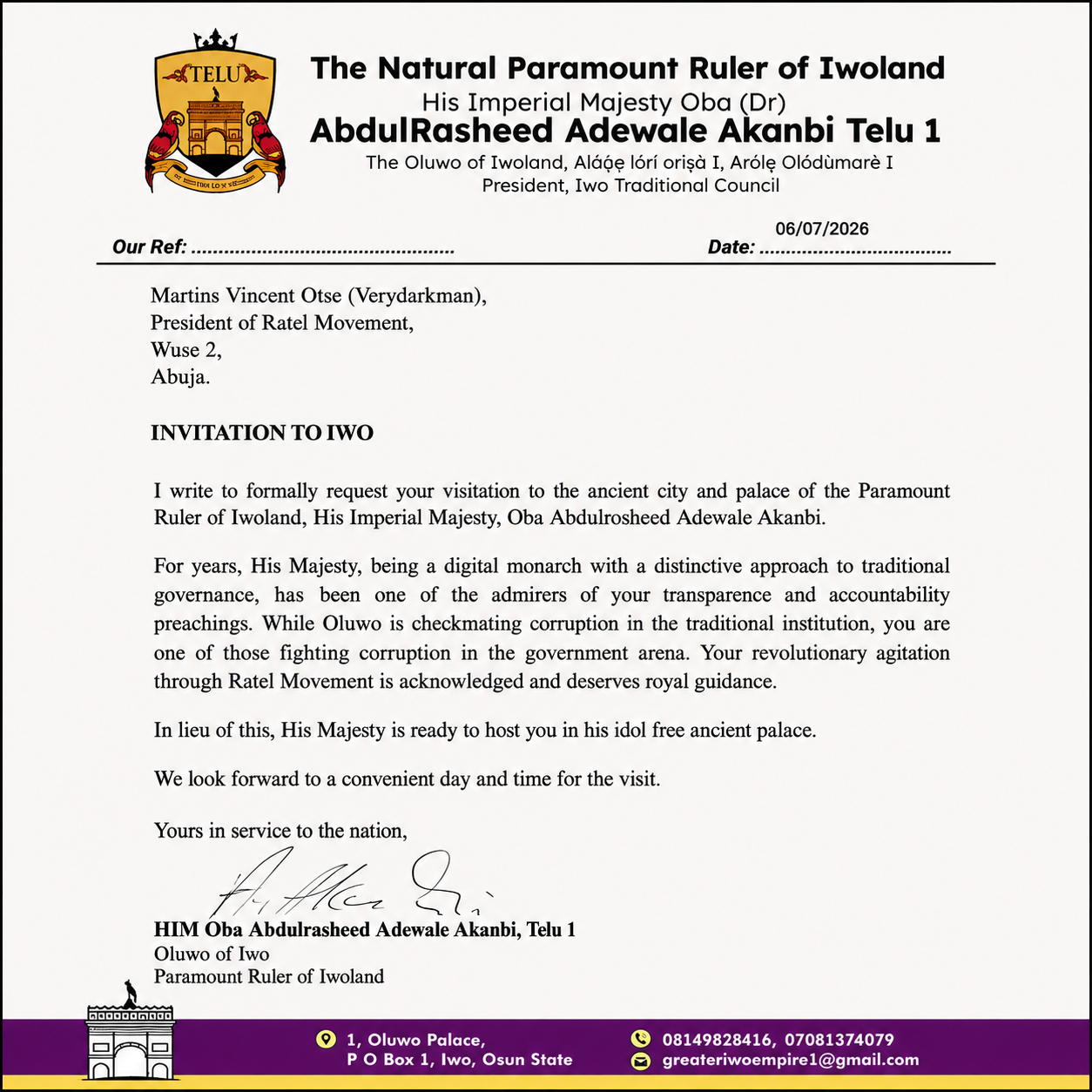
The recent conferment of the title "Atayese of Yoruba Land" on Martins Vincent Otse (VeryDarkMan) by the Oluwo of Iwo has generated admiration in some quarters and criticism in others. Much of the conversation has revolved around personalities—whether VDM deserves the honour, whether the Oluwo acted appropriately, or whether critics are simply resistant to change.
Those questions are legitimate. But they are not the most enduring ones.
The more fundamental question is this: What does a Yoruba chieftaincy title represent?
This reflection is therefore not about diminishing VDM or condemning the Oluwo. Rather, it asks what happens when long-established institutions begin to stretch the conventions that have historically given them legitimacy.
The Title That Crossed Boundaries
The title "Atayese of Yoruba Land" is rich in symbolism. Traditionally, Atayese evokes the image of a reconciler—one who restores harmony and strengthens communal bonds. The question lies not in the title itself, but in the geographical scope attached to it.
The Yoruba are not governed under a single traditional throne. They are a civilisation of interconnected kingdoms—Oyo, Ife, Ijebu, Ekiti, Ondo, Egba, Ijesa, Iwo and many others—each with its own monarchy, customs and sphere of authority. While some royal stools enjoy broader historical or spiritual influence than others, influence is not the same as universal jurisdiction.
It is therefore difficult to argue that any single Yoruba monarch possesses the customary or moral authority to confer a title that purports to speak for the entirety of Yorubaland.
Chieftaincy titles are more than ceremonial honours. They are institutional expressions of history, identity and communal responsibility. Their legitimacy derives not only from the dignity of the throne that bestows them but also from the recognised boundaries within which that authority operates.
This naturally raises another question: why "Atayese of Yoruba Land" rather than "Atayese of Iwo"? A title rooted in Iwo would have honoured both the recipient and the authority of the throne without extending beyond its customary sphere.
Recognition Is Not the Same as Incorporation
None of this diminishes VDM's influence or his contribution to public accountability. Societies should recognise those who serve them.
The question is not whether distinguished individuals deserve honour, but what form that honour should take.
Yoruba traditional institutions have always possessed ways of celebrating exceptional guests without incorporating them into the formal hierarchy of chieftaincy. Royal receptions, commendations and ceremonial distinctions all recognise achievement while preserving the institutional meaning of traditional titles.
A commendation recognises contribution.
A chieftaincy title incorporates the recipient into a traditional order.
That distinction is subtle, but fundamental.
The Palace and Its Custodianship
The Oluwo has openly professed his Islamic faith throughout his reign and recently described his palace as an "idol-free ancient palace."
The issue is not whether an Oba may be Muslim or Christian. Yoruba history has long accommodated monarchs whose personal faith differed from aspects of indigenous religious practice.
The real question is whether personal conviction should alter the cultural responsibilities attached to the throne.
A Yoruba monarch is more than a ruler; he is the custodian of a civilisation inherited across generations. His responsibility extends beyond preserving what he personally believes to safeguarding the traditions, symbols and collective memory entrusted to his office.
History provides admirable examples. The late Alaafin Lamidi Adeyemi remained a practising Muslim while preserving the traditions associated with the Alaafin's stool. Likewise, the Ooni of Ife openly professes Christianity while continuing to uphold festivals central to Yoruba civilisation.
A curator need not personally embrace every artefact entrusted to his care. His responsibility is to preserve it faithfully for those who come after him.
When Institutions Lose Meaning
Many Yoruba monarchs continue to serve their communities with remarkable dignity, preserving festivals, mediating disputes and promoting Yoruba culture. This reflection is therefore not an indictment of the institution itself.
It is a concern about a growing tendency.
Yoruba chieftaincy once represented one of Africa's most sophisticated systems of governance. Titles reflected service, wisdom, achievement and responsibility. Offices carried obligations as much as honour.
Today, public perception increasingly tells a different story. Businessmen accumulate titles across multiple kingdoms. Politicians receive honours often difficult to distinguish from patronage. Celebrities are crowned amid social media spectacle.
Whether every recipient deserves recognition is almost beside the point.
When honours become detached from clearly understood institutional purpose, they gradually lose the meaning that once made them worthy of respect.
A throne derives its dignity not from the number of titles it confers, but from the discipline with which those honours are bestowed.
The Throne and Public Life
Yoruba political philosophy places the Oba above partisan politics but never above public responsibility. A monarch should neither become the spokesman of any political faction nor retreat into ceremonial silence when matters affecting the welfare of the people arise.
The Oluwo's engagement with VDM therefore occupies a delicate space. Bringing influential voices into dialogue with traditional institutions is not objectionable. Yet public admiration expressed by a monarch inevitably carries symbolic weight and may be interpreted as institutional endorsement.
The greatest Yoruba monarchs understood that influence is exercised not merely through boldness but through restraint.
A Reflection Worth Having
This essay is ultimately less about one title than about the future of an institution that has shaped Yoruba civilisation for centuries.
Cultures rarely disappear through dramatic collapse. More often, they change through gradual shifts in meaning.
The chieftaincy institution remains one of the Yoruba people's greatest inheritances. Preserving its integrity requires more than public reverence; it requires restraint from those entrusted with its stewardship.
If the conferment of "Atayese of Yoruba Land" encourages a broader conversation about kingship, traditional authority and cultural custodianship, then it will have served a purpose greater than the ceremony itself.
A throne is a trust. A crown is a covenant. Institutions survive not by claiming more than they are, but by remaining faithful to what they have always been. In an age of diffusion, that fidelity may be their greatest strength.
Àsìkò ò dá dúró fún enikankan. Ṣùgbọ́n àṣà wa lè dúró, tí àwọn olùtọ́jú rẹ̀ bá mọ̀ iṣẹ́ wọn.
Time waits for no one. But our culture can endure, if its custodians know their duty.


9 comments
Log in to join the conversationEditor's Note (17 July 2026):
Following the publication of this essay, subsequent reports and videos relating to the conferment have described the honour variously as "Atayese of Yorubaland" and "Atayese I of Nigeria."
These developments have been noted. They do not, however, alter the central thesis of this essay. The argument has never been about whether a traditional ruler may confer honours, but about the constitutional scope of traditional authority, the distinction between honorary recognition and metaphysical legitimacy, and the responsibilities of cultural custodianship within Yoruba thought.
References that may have appeared to speak of "Yorubaland" collectively should therefore be understood more precisely as referring to the specific traditional institution and individuals involved in the conferment.
The system you mean is the people in charge of regulating the system
You're right that people regulate systems. My point is that institutions are ultimately expressed through the people who interpret and enforce them. So when discussing tradition, both the institution and its custodians deserve scrutiny.
So what's your point?
Simply that public popularity and traditional legitimacy are not always the same thing. They can intersect, but one doesn't automatically confer the other. That distinction was the essence of my post.
Thank you
If it is not against their tradition, I don't see an issue here
are you saying vdm is not eligible to the chieftaincy title
Thank you for engaging with the piece.
Not at all. My argument is not about VDM's eligibility or worthiness as an individual. In fact, I expressly acknowledged that his advocacy and public influence deserve recognition.
The question I raised is institutional rather than personal.
Should a single traditional ruler confer a title whose scope appears to extend to the entirety of Yoruba land? Put differently, where should the boundaries of a monarch's customary authority begin and end?
Those are different questions.
One can believe VDM deserves honour while still asking whether the particular title and its territorial scope align with the traditions and institutional logic of Yoruba chieftaincy.
My concern is therefore less about the recipient and more about the institution that confers the honour. The essay uses this event as an opportunity to reflect on how traditional institutions preserve their meaning and legitimacy over time.