
The Orange Lie: How the Same Fanta Bottle Holds Two Different Futures
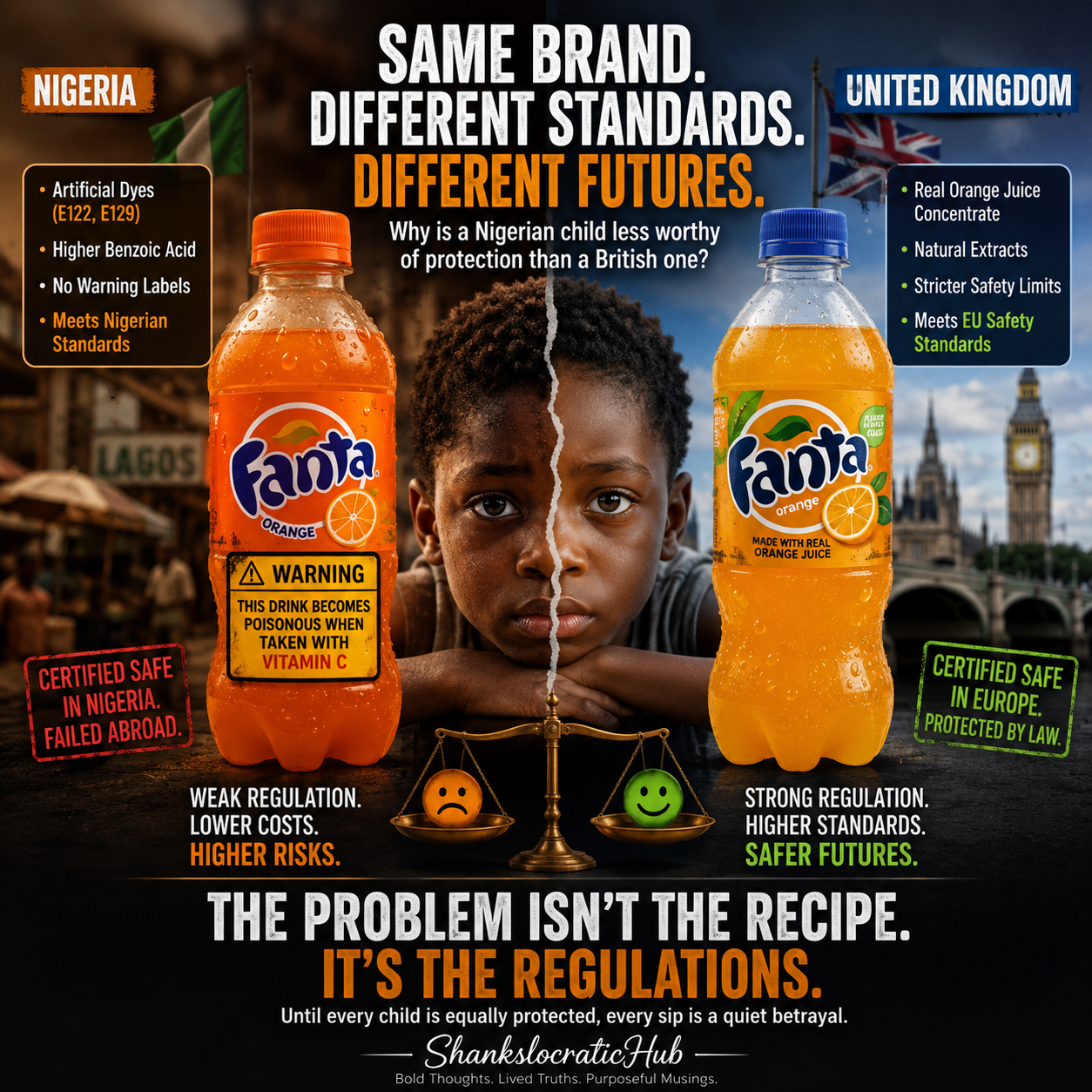
In 2007, Nigerian businessman Fijabi Adebo exported Fanta and Sprite, bottled in Lagos and certified safe by NAFDAC to the United Kingdom. UK authorities seized the drinks, tested them, and destroyed them because their benzoic acid and sunset yellow levels exceeded EU safety limits.
Adebo sued the Nigeria Bottling Company (NBC) and NAFDAC. In 2017, a Lagos High Court ruled NBC had complied with Nigerian regulations, but Justice Adedayo Oyebanji delivered a stinging verdict against the regulator:
"NAFDAC has been grossly irresponsible in its regulatory duties... It has failed the citizens of this great nation."
The court ordered every affected bottle to carry a warning that the drink becomes poisonous when taken with Vitamin C.
Pause on that.
The same factory. The same brand. The same orange drink. Yet one formulation is acceptable for European consumers, while another carries a poison warning for Nigerians.
The Chemistry of Inequality
The problem did not end in 2017.
In 2024, independent laboratory tests by GST Nigeria reported that Nigerian Fanta contained synthetic dyes, including Carmoisine (E122) and Allura Red (E129), additives banned or heavily restricted in parts of Europe. UK Fanta, by contrast, contains orange juice concentrate and vegetable extracts instead of artificial colourants.
The 2007 Southampton Study linked several of these dyes to hyperactivity in children. Across Europe, warning labels are mandatory, while some countries prohibit their use in foods for young children. Nigeria requires neither warnings nor reformulation.
This is bigger than one soft drink. Multinationals routinely adapt products to the strictness or weakness of local regulation. Strong regulators encourage safer formulations. Weak oversight permits cheaper alternatives.
A Regulator on Life Support
NAFDAC employs about 2,000 staff nationwide. Of its ₦7.65 billion 2023 budget, over 97% went to salaries, leaving just ₦222.7 million for laboratories, equipment, inspections and enforcement. The agency increasingly depends on donor-funded testing facilities.
By comparison, the European Food Safety Authority operates on a budget exceeding €100 million with hundreds of scientific experts.
NAFDAC's 2024 report listed hundreds of inspections and over 51,000 substandard products removed from circulation. Yet those figures must be measured against a population exceeding 220 million and vast informal markets. Even The Guardian Nigeria described the agency as a "toothless bulldog" against powerful manufacturing interests.
The Human Cost
The WHO estimates unsafe food causes 600 million illnesses and 420,000 deaths globally every year.
Nigeria bears a disproportionate burden. CAFSANI estimates about 173 million diarrhoeal cases and 33,000 deaths annually from unsafe food, while a 2025 Springer study estimated food safety failures may contribute to as many as 200,000 deaths each year.
These are not abstract statistics. They are children hospitalised, families bankrupted, and preventable deaths quietly accepted as normal.
Fanta Is Not the Exception
In 2024, Swiss NGO Public Eye revealed that Nestlé added sugar to Cerelac infant cereals sold across many African countries, including Nigeria, while selling sugar-free versions in Switzerland, Germany and the UK.
More than 90% of African Cerelac products contained added sugar. Some servings contained 7.5 grams—almost two sugar cubes. The WHO warns that early sugar exposure encourages lifelong unhealthy eating habits and increases obesity risk.
Following public backlash in India, Nestlé removed added sugar from 14 products. African formulations largely remained unchanged.
This was not an accident. It was market segmentation based on regulatory weakness.
The Architecture of Apathy
Europe generally applies the precautionary principle: restrict questionable additives until proven safe.
Nigeria largely does the opposite. Additives remain acceptable until overwhelming evidence proves otherwise, placing the burden on consumers instead of manufacturers.
The problem is also financial. Nigeria allocated only about 4.6% of its 2024 budget to health—far below the African Union's 15% Abuja Declaration target. Food safety inevitably suffers.
Meanwhile, multinational companies are major employers, taxpayers and influential corporate partners. Regulators expected to police them often lack both the resources and political backing to do so effectively.
What the Label Doesn't Tell You
Read a bottle of Nigerian Fanta.
You will see carbonated water, sugar, citric acid and E-numbers.
What you will not see is any warning that some colourants have been linked to hyperactivity, that formulations differ across markets, or that products meeting Nigerian standards have previously failed European safety tests.
The label stays silent because the law permits silence.
The Question We Keep Avoiding
Why should a Nigerian child receive weaker protection than a British child?
Multinationals argue that they simply comply with local laws. Legally, that may be true. Morally, it is insufficient.
The bottle of Fanta on a Nigerian shelf asks a deeper question: do we regard citizens as people whose health deserves equal protection, or merely as consumers in a profitable market?
Justice Oyebanji's poison-warning order acknowledged that something was wrong. But warnings are not solutions.
The real solution is a Nigeria where products manufactured for Lagos meet the same safety standards as those sold in London; where regulators have the funding and independence to enforce those standards; and where no child's health depends on their postcode.
Until then, every bottle tells the same uncomfortable story:
Some lives are still valued less than others.
References: Lagos High Court, Fijabi Adebo Holdings Ltd v. Nigeria Bottling Company Plc & NAFDAC (2017); NAFDAC Annual Report (2024); Public Eye, How Nestlé Gets Babies Hooked on Sugar (2024); WHO, Estimates of the Global Burden of Foodborne Diseases; McCann et al., Southampton Study (2007); The Guardian Nigeria (2023); Springer Journal of Food Safety (2025); EU Rapid Alert System for Food and Feed (RASFF).




9 comments
Log in to join the conversationEven all these little sachet water companies don't have NAFDAC reg numbers anymore
Those Nigerian versions of abroad products are most times fake. What does NAFDAC do about it?
Is anything even safe in this country?
Everything in this country works under corruption
Our things are always low quality
Nafdac doesn't even know their job. Even food they stop, somehow it still sells everywhere
Hmmmm
This is not just something of drinks it has been our lifestyle here
Seriously