
The Mirror and the Gap: How Comparison Builds Us, Then Quietly Unmakes the Builder
On ambition, invisible scoreboards, and why Ronaldo's missing World Cup might be his most honest trophy.
I. The Engine and the Exhaust
Comparison is hardwired into us — once a survival tool, now a daily reflex against LinkedIn updates and vacation albums. The self-help world calls it toxic, but it's more nuanced: comparison is ambivalent. The same mechanism that drove Ronaldo to sculpt himself into a machine of precision is the one that whispered at 3 a.m.: "But Messi has the World Cup."
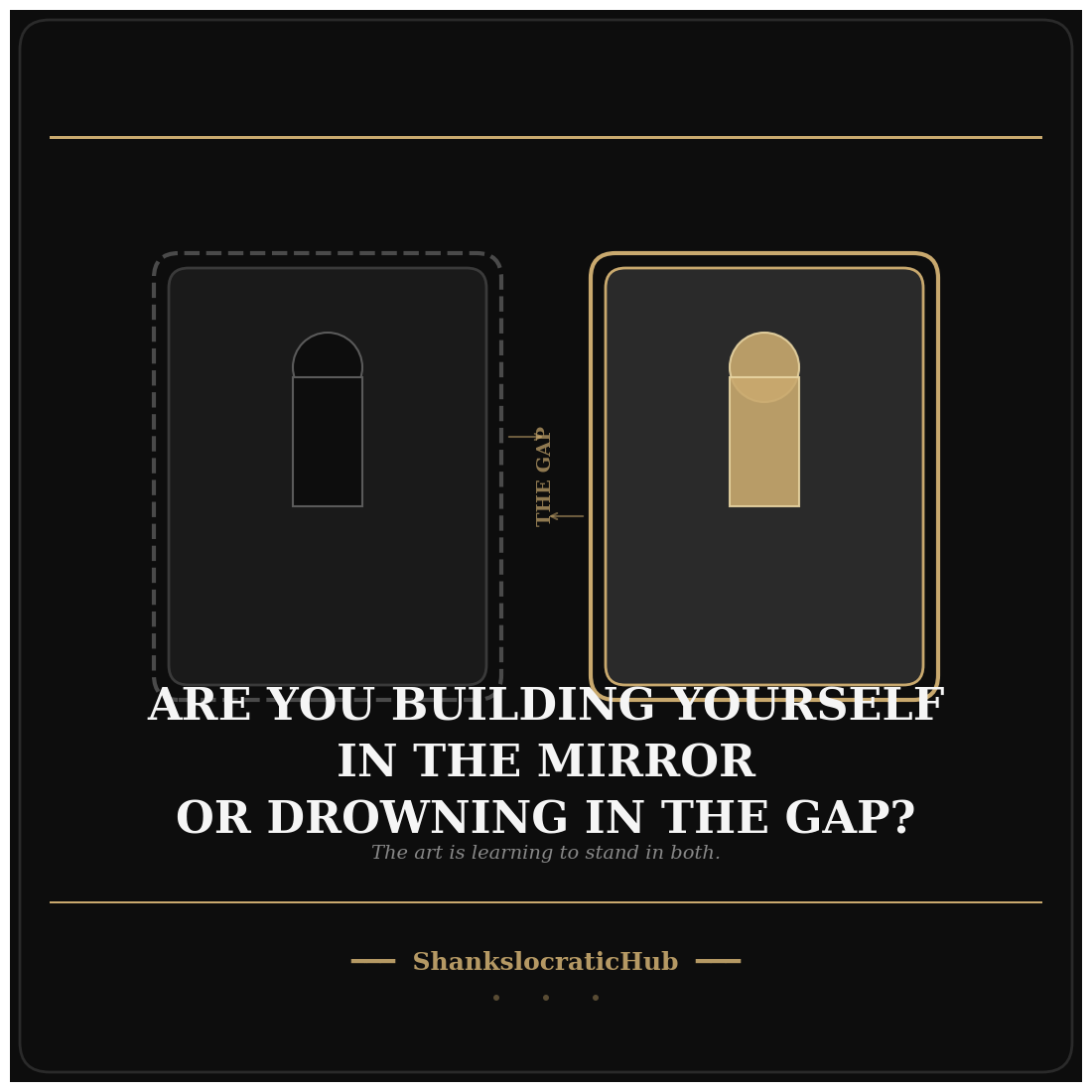
The mirror shows possibility. The gap shows absence. We need both. We just never learned to read the gap correctly.
II. The Ronaldo Paradox: When the Scoreboard Lies
Five Champions Leagues. Five Ballon d'Ors. Over 900 goals. By every metric, Ronaldo is among the two greatest ever. Yet one stained glass window remains untouched: the World Cup.
In comparison's binary trap, Ronaldo is "less than." But reality isn't binary. The World Cup is a team sport played every four years in single-elimination chaos — individual brilliance has structural limits. Portugal was never Brazil 1970.
Still, Ronaldo fed the comparison. The Messi rivalry wasn't media-imposed alone — he embraced it, used it, perhaps needed it as fuel. But engines produce exhaust. When Portugal fell in 2022 and Ronaldo wept on the bench, the world saw a man conquered by an external metric he couldn't engineer.
The bright side: comparison built his relentless evolution. The dark side: it may have denied him peace when he needed it most.
III. The Invisible Scoreboards
We obsess over comparing outcomes — trophies, salaries, followers. We rarely compare inputs with honesty.
Ronaldo's body is a temple and a prison. No sugar, no alcohol, cryotherapy, timed naps. Admirable. Also a life of extreme constraint most would find unbearable. When we compare ourselves to him, we match our outcomes to his while remaining blind to the costs we didn't pay.
The dark side isn't that comparison makes us feel bad. It's that it makes us feel bad about the wrong things. We crave the trophy without the temple, the highlight without the 4 a.m. sessions, the World Cup without grasping that it requires collective alignment and luck no one controls.
IV. The Unnamed Bright Side: Comparison as Compass
Yet comparison can expand rather than shrink.
When a girl in a favela sees Marta play, she doesn't feel small — she feels possibility . When a first-gen student reads about escaping poverty through education, the comparison is a signal: the door is real, it opens.
Ronaldo, for millions, is this compass. Not "be him," but "the distance between where you are and where you could be is bridgeable — if you pay the toll."
The bright side is aspirational honesty. If Ronaldo's discipline clarifies that you value spontaneity more, that's not failure. That's self-knowledge purchased cheaply.
V. Comparative Grief: The Unexplored Wound
Here's what we lack language for: comparative grief.
It's what Ronaldo likely felt in Qatar. Not just sadness at losing, but grief at the narrative closing . The story comparison culture wrote — Ronaldo vs. Messi, the World Cup as resolution — was ending without his authorship. He wasn't just losing a tournament. He was losing control of his own mythology.
We all know this. The friend who marries while you're single — their love doesn't begrudge yours, but the comparison rewrites your story without consent. The funded colleague, the thriving child, the success that introduces shame you never invited.
Comparative grief isn't envy. Envy wants what others have. Comparative grief mourns what the self has lost in the shadow of another's gain. It's not about them. It's about the story you told yourself, and how their success makes it feel like fiction.
This is comparison's deepest shadow: it doesn't just make us want more. It makes us grieve narratives we were never guaranteed.
VI. The Quiet Rebellion: Living in the Gap
"Stop comparing" is neurologically impossible. The question is: what do we measure against?
The less-explored path shifts from horizontal comparison (me vs. you) to vertical comparison (me vs. who I was). Build an internal scoreboard so robust that external ones become data, not verdicts.
Ronaldo's move to Saudi Arabia was read as surrender. Perhaps it was braver: a refusal to let the World Cup gap define his remaining years. He kept scoring. Kept working. Kept existing in the gap without letting it consume him.
The radical act: continue creating in the space between who you are and who you thought you'd be. Let the gap exist without letting it become a grave.
VII. The Mirror, Finally
Comparison is neither villain nor hero. It is a mirror, and mirrors are neutral.
The bright side: they show form, possibility, evidence that humans can transcend their starting conditions.
The dark side: they flatten. They remove context. They don't show the cryotherapy chamber, the estranged relationships, the 3 a.m. doubts. They don't show the team, the luck, the geopolitical lottery of birth and timing.
Ronaldo's career is a masterclass in both. He used comparison to become superhuman. He may have also let it steal the one thing no trophy provides: the ability to say, "I was enough, regardless."
This article isn't about stopping comparison. It's about becoming bilingual in it — fluent enough to read the mirror, wise enough to know when the gap is lying, brave enough to keep building in the space between.
Because Ronaldo doesn't need the World Cup to be Ronaldo. And you don't need their metric to be your own impossible, unfinished, incomparable self.
The mirror shows you what is. The gap shows you what could be. The art is learning to stand in both without letting either swallow you whole.



8 comments
Log in to join the conversationI never compare myself with any one
Very long and interesting
Interesting !!
Great piece
interesting
What's one comparison that made you better and one that quietly burned you? 👇
comparison, doesn't make anyone better it just takes away ones joy
The comparison btw my past self and my future self