
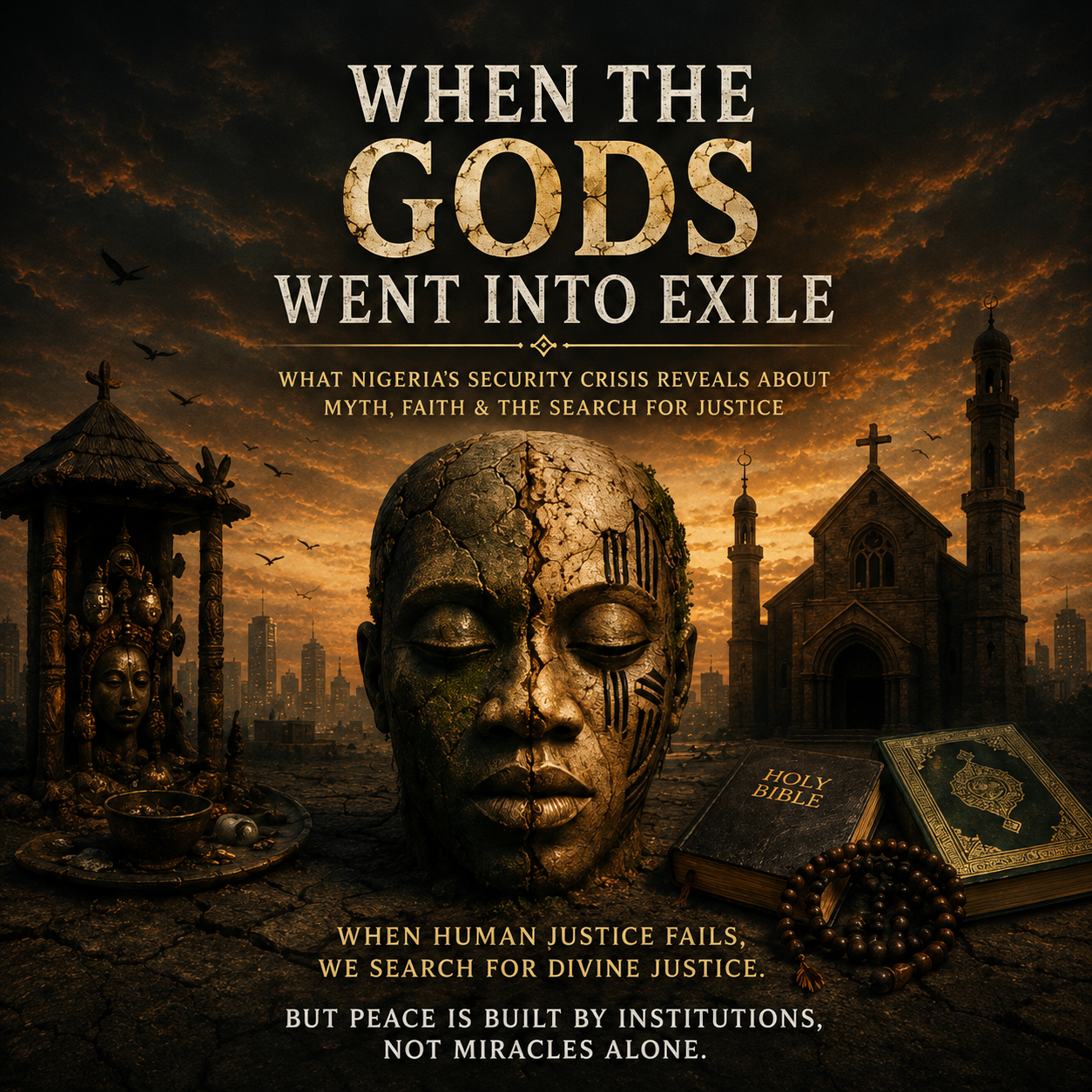
When the Gods Went into Exile: What Nigeria's Security Crisis Reveals About Myth, Faith and the Search for Justice
"When justice disappears from the marketplace, people begin searching for it in the heavens."
This reflection is inspired by the prolonged captivity of the teachers and students abducted in the Ogbomoso kidnap incident, whose ordeal reaches fifty days on July 4, 2026. It stands in solidarity with them, their families, and every Nigerian affected by insecurity.
As hope wears thin, public conversations have taken an interesting turn. Beyond demands for better policing and accountable leadership, some Nigerians argue that the abandonment of indigenous spiritual traditions also meant abandoning a powerful culture of accountability. Others maintain that the answer lies in fervent prayer, fasting, Qur'anic recitations, ruqyah, anointing oil, and other expressions of faith rooted in Christianity and Islam.
This raises a deeper question: When human justice appears powerless, why do societies instinctively seek supernatural justice?
Long before colonial rule, many Nigerian societies had sophisticated moral systems reinforced by mythology. Among the Yoruba, deities such as Ṣàngó, Ògún, and Èṣù symbolised justice, truth, covenants, choice, and consequence. Ayelala, revered in parts of southern Nigeria, was feared for exposing thieves and punishing perjury. The Igbo looked to Amadioha and Ala as guardians of justice and moral order, while the Tiv, alongside institutions such as the Ekpe society in parts of southeastern Nigeria, upheld communal discipline through sacred traditions.
Whether these beliefs are accepted literally is a matter of personal faith. Historically, however, they helped create societies where people believed wrongdoing would eventually be exposed, even when no human witness existed.
Colonialism transformed Nigeria's religious landscape, replacing many traditional institutions with Christianity, Islam, and colonial legal systems. Yet the human desire for transcendent justice never disappeared—it simply changed language. Where people once feared breaking an oath before Ayelala or Ṣàngó, many today pray against evil, recite Psalms or Qur'anic verses, seek spiritual protection, and trust God to bring justice. The symbols changed; the longing for accountability remained.
The harder question is why deeply religious societies can still struggle with insecurity while some less religious societies maintain stronger institutions and lower levels of violent crime. This is not an argument against faith or for traditional religion. Rather, it reminds us that faith, mythology, and institutions serve different purposes.
Faith nurtures hope. Religion shapes character. Myth preserves collective memory. None of them replaces competent governance, effective policing, impartial courts, intelligence gathering, or accountable leadership. Even traditional societies understood this: the gods did not patrol forests—people did. The sacred reinforced the social; it did not replace it.
Perhaps the recurring search for supernatural justice says less about God's silence than about institutional failure. When courts lose credibility and corruption weakens justice, people naturally begin searching beyond the state—for answers in shrines, churches, mosques, prayer grounds, sacred groves, miracle waters, and whispered prayers.
History suggests that lasting peace is secured not by prayer alone, ritual alone, or nostalgia alone, but when moral conviction is matched by responsible citizenship and institutions worthy of public trust.
The real question, then, is not whether the gods have abandoned Nigeria, but whether Nigerians have abandoned the difficult work of building a society where justice no longer depends on miracles.




17 comments
Log in to join the conversationThis is a powerful reminder that no amount of spirituality can substitute for functioning institutions and the rule of law.
Faith gives people hope, but hope alone cannot replace good governance, justice, and effective security.
When institutions fail, people naturally look beyond them. That's a pattern repeated throughout history, not just in Nigeria.
The line, "the gods did not patrol forests—people did," captures the central message perfectly. Accountability requires action
Whether one believes in traditional religion, Christianity, or Islam, justice ultimately depends on people building institutions that work
This isn't really a debate about religion; it's a conversation about why citizens lose confidence in the systems meant to protect them
A society shouldn't have to rely on miracles for justice. Justice should be predictable, accessible, and impartial.
The most striking point is that our search for supernatural solutions often reflects our frustration with earthly institutions.
History shows that strong moral values and strong institutions work best together. One without the other leaves dangerous gaps.
The closing question is worth reflecting on: perhaps the challenge isn't whether divine help exists, but whether we've done enough to build a nation where justice doesn't depend on extraordinary intervention.
Interesting
This is a thought-provoking piece. It raises important questions about justice, leadership, and the role of faith in difficult times.
Faith can inspire hope, but institutions must also work effectively to protect lives and uphold justice.
The real challenge is turning these conversations into meaningful action that improves lives.
The connection between belief, culture, and the search for justice is an interesting perspective that deserves reflection.
True
Nigeria has