
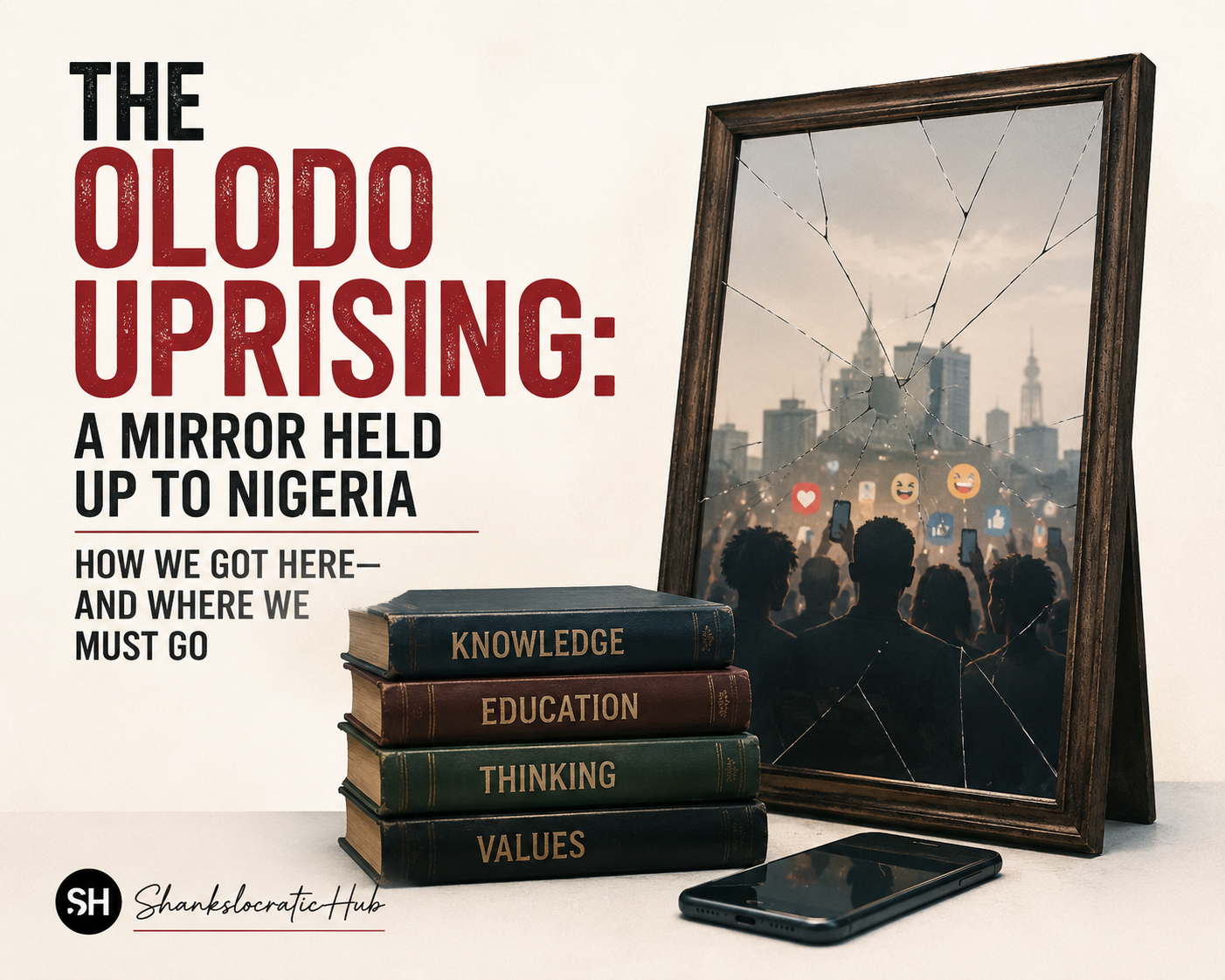
The Olodo Uprising: A Mirror Held Up to Nigeria
How We Got Here—and Where We Must Go
The phrase "Olodo Uprising" has swept across Nigerian social media with astonishing speed. To some, it is a hilarious meme. To others, it is an unfair insult directed at people who found success outside the classroom. Still others see it as a necessary wake-up call for a nation gradually losing its reverence for knowledge.
But perhaps the biggest mistake we can make is to think this conversation is about "olodos."
It is not.
The "Olodo Uprising" is merely a mirror held up to Nigeria. What we are seeing reflected is not one influencer, one celebrity, or one viral moment. We are seeing ourselves—our values, our incentives, our institutions, and the culture we have quietly allowed to evolve.
We Didn't Get Here Overnight
Societies do not suddenly become anti-intellectual.
They drift there.
For decades, public education has suffered neglect. Libraries disappeared from many communities. Reading became associated with examinations rather than curiosity. Academic excellence gradually lost its prestige as economic hardship made survival the immediate priority.
At the same time, millions of educated Nigerians discovered a painful contradiction: degrees no longer guaranteed dignity, employment, or financial security.
As this reality deepened, a subtle cultural shift emerged.
Education remained respected in theory, but no longer appeared essential in practice.
That shift changed everything.
When Success Stops Looking Like Scholarship
Every generation watches the people society rewards.
Young Nigerians are no different.
When teachers struggle to pay their bills while entertainers, pranksters and controversy merchants accumulate wealth, influence and admiration, society begins communicating a powerful lesson without ever saying the words aloud:
Knowledge is admirable. Attention is profitable.
People naturally move towards whatever appears to work.
The issue is not that entertainment exists. Every healthy society needs artists, comedians and creators.
The problem begins when entertainment no longer coexists with intellectual excellence but starts replacing it as the highest cultural aspiration.
The Algorithm Didn't Create the Problem—It Amplified It
Social media is often blamed for everything.
That is too simplistic.
The algorithms did not create anti-intellectualism.
They simply rewarded it.
Digital platforms are designed to maximise engagement, not wisdom. Outrage spreads faster than nuance. Simplicity often outperforms complexity. Loudness frequently defeats substance.
In such an environment, virality can easily become confused with value.
The result is a generation that sometimes mistakes popularity for credibility.
But This Is Bigger Than English
This debate is not about grammar.
It is not about pronunciation.
It is certainly not about mocking people whose educational opportunities were limited by circumstances beyond their control.
Many of those now labelled "olodo" are themselves products of broken schools, poor governance and economic hardship.
Mocking them solves nothing.
Yet neither should society romanticise intellectual laziness.
There is an important difference between "lacking opportunity" and "refusing growth".
One deserves empathy.
The other deserves honest challenge.
The Danger We Rarely Discuss
Civilisations decline long before they collapse.
They decline when excellence stops inspiring admiration.
When correction becomes an insult.
When curiosity becomes uncool.
When reading attracts ridicule.
When expertise becomes suspicious.
When confidence consistently outweighs competence.
Every civilisation eventually becomes what it repeatedly celebrates.
If a nation applauds ignorance often enough, ignorance slowly becomes cultural currency.
So Where Do We Go From Here?
The answer is not public shaming.
Neither is it elitism.
Our task is far more difficult.
We must make excellence attractive again.
We must celebrate teachers as enthusiastically as celebrities.
Parents must reward curiosity at home.
Schools must prioritise critical thinking over memorisation.
Media organisations and digital creators should recognise that influence carries responsibility, not merely reach.
Government must invest in education—not only by constructing classrooms but by restoring dignity to learning and to those who dedicate their lives to it.
Most importantly, each of us must reconsider what we reward every single day.
Every click.
Every share.
Every follow.
Every applause.
Because culture is not built only by governments.
It is built by millions of ordinary choices.
The Mirror Before Us
Perhaps that is why the "Olodo Uprising" matters.
Not because it tells us anything new.
But because it forces us to confront truths we have quietly ignored for years.
The question is no longer whether Nigeria has an anti-intellectual problem.
The more pressing question is whether we are prepared to rebuild a culture where knowledge commands respect, curiosity is admired, and learning is seen not as a burden but as a pathway to personal fulfilment and national progress.
The mirror has already been lifted.
Whether we choose to look away or use the reflection to change remains entirely up to us.



23 comments
Log in to join the conversationAre they prepared? Is the problem indeed
This issue may come now and go like the rest
It's up to us really
Good one
A society that celebrates confidence over competence will eventually pay the price. Expertise still matters, even if it isn't always viral.
The goal shouldn't be to shame entertainers or influencers. We need a culture where intelligence and entertainment can thrive side by side.
This is one of the few posts on the "Olodo Uprising" that looks beyond the memes and asks the bigger question: What kind of values are we passing on to the next generation?
This is a very important question
The section about every click, share, and follow building culture really made me think. We all contribute to what becomes popular.
We should stop mocking people for not knowing something and instead encourage them to learn. Growth should never be seen as embarrassing.
One thing missing from this conversation is accountability from government. You can't expect people to value education when graduates are unemployed and teachers are underpaid.
Social media didn't create anti-intellectualism, but it definitely rewards it. The algorithm loves entertainment more than expertise.
I agree that the problem isn't people with limited educational opportunities. The real issue is when we stop valuing growth and curiosity altogether.
The line "Knowledge is admirable. Attention is profitable." perfectly captures the challenge facing young Nigerians today.
This isn't really about "olodos"; it's about the kind of society we're becoming and what we choose to celebrate. That's the uncomfortable truth.
That is it. Realigning our feed. Check other countries, they still have intelligent influencers with sense. For example, Mr Beast, he isn't giving olodo vibes in his account. Even Kai Cenat and the rest
Deep insight
Interesting perspective. Sometimes memes reveal deeper societal issues.
i cant read all this oh
it is long sha
I don't get it
Who fit rise make him rise
Omo