
In the future, parents may no longer be the primary people responsible for raising children.
Instead, governments or large institutions could take on that role through highly structured programs designed to prepare children for the needs of society.
At first, this may sound extreme, but elements of this idea have appeared in philosophy, science fiction, and political theory for centuries.
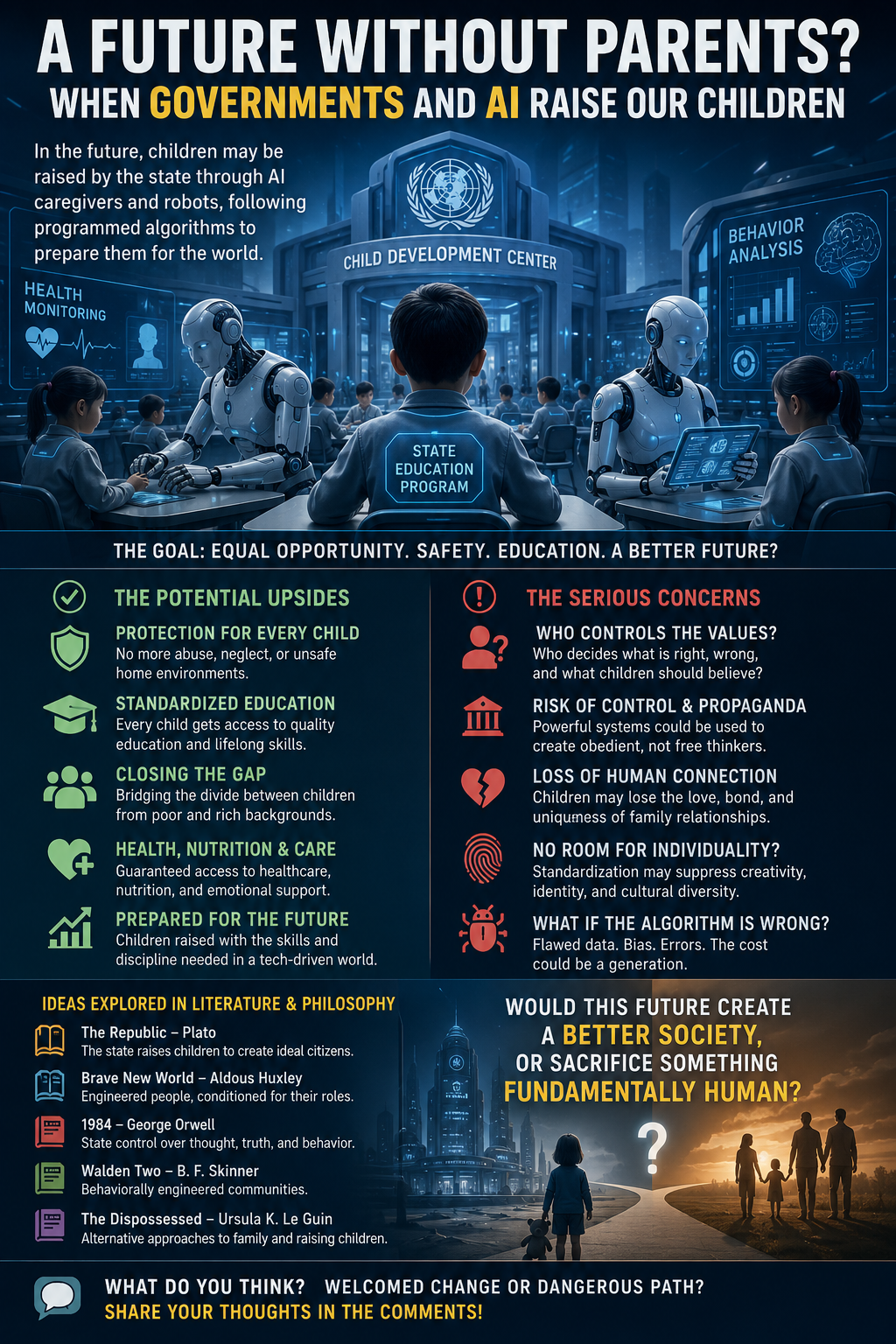
In Plato’s book, The Republic, he proposed that children of the guardian class should be raised collectively by the state rather than by individual families. His argument was that society could produce better citizens if education and upbringing were standardized and carefully controlled.
Centuries later, Aldous Huxley’s Brave New World imagined a society where children were conditioned from birth to fit predetermined social roles. More recently, futuristic discussions about artificial intelligence, robotics, and algorithmic governance have revived similar questions: if technology can teach, monitor, and guide children more effectively than some parents, should it?
Today we are training AI models that can learn, reason, and communicate. At the same time, engineers are building robots that can walk, interact, and mimic human behavior. In the future, these machines may possess highly realistic synthetic skin and facial expressions, making them almost indistinguishable from humans except for their identification labels.
Imagine a world where government-operated foster homes are staffed by AI caregivers and humanoid robots. These systems would raise children according to carefully designed algorithms intended to maximize education, emotional stability, health, and productivity.
Supporters might argue that such a system could solve many problems:
• Children would be protected from abusive or neglectful parents.
• Every child would receive a standardized education and access to resources.
• The gap between children raised in poverty and those raised in wealthy households could be reduced.
• Nutrition, healthcare, and life skills could be guaranteed for everyone.
• Society could ensure that every child develops the skills needed to function in an increasingly technological world.
However, critics would raise serious concerns:
• Who decides what values children should be taught?
• Could governments misuse such power to shape citizens for political purposes?
• Would children lose the emotional bonds that come from family relationships?
• Could a standardized upbringing suppress individuality, creativity, and cultural diversity?
• What happens when the algorithm is wrong?
History shows that attempts to engineer society often produce unintended consequences. While technology may become increasingly capable of assisting parents, replacing parents entirely is a much bigger question.
Would a future where children are raised primarily by AI systems and government institutions create a better society, or would it sacrifice something fundamentally human?
Share your thoughts in the comments.

28 comments
Log in to join the conversationChildren need more than information and supervision—they need relationships, guidance, and genuine human connection.
If machines start handling more parenting responsibilities, we must ensure children don't lose the human touch that helps them thrive.
The more technology advances, the more important authentic human relationships may become.
As society evolves, the challenge will be balancing convenience with meaningful family relationships.
The real question isn't whether parents will be replaced, but how technology will reshape parenting in the years ahead
Any system powerful enough to raise every child is powerful enough to control every citizen.
The greatest innovations should strengthen families, not make them obsolete.
That innovation is absolutely crazy
The future may involve AI co-parenting tools, but completely removing parents feels unrealistic.
Agreed
AI may be able to teach mathematics and science, but can it truly teach empathy and unconditional love?
A child's upbringing should involve both structure and genuine emotional attachment.
If governments raise children, who raises the government officials making those decisions?
This sounds like a solution that prioritizes efficiency over humanity.
The human touch cannot be fully replicated by even the most advanced machine.
Technology works best when it complements human relationships, not replaces them.
Some parents fail their children, but replacing all parents because of that seems extreme.
Its not gonna happen
The question isn't whether AI can raise children it's whether it should.
A society without strong family bonds may be technologically advanced but emotionally impoverished.
This idea could reduce inequality, but it could also create new forms of social control.
Children learn more than facts from parents; they learn identity, culture, and emotional resilience.
History has shown that giving governments too much control over people's lives can have unintended consequences.